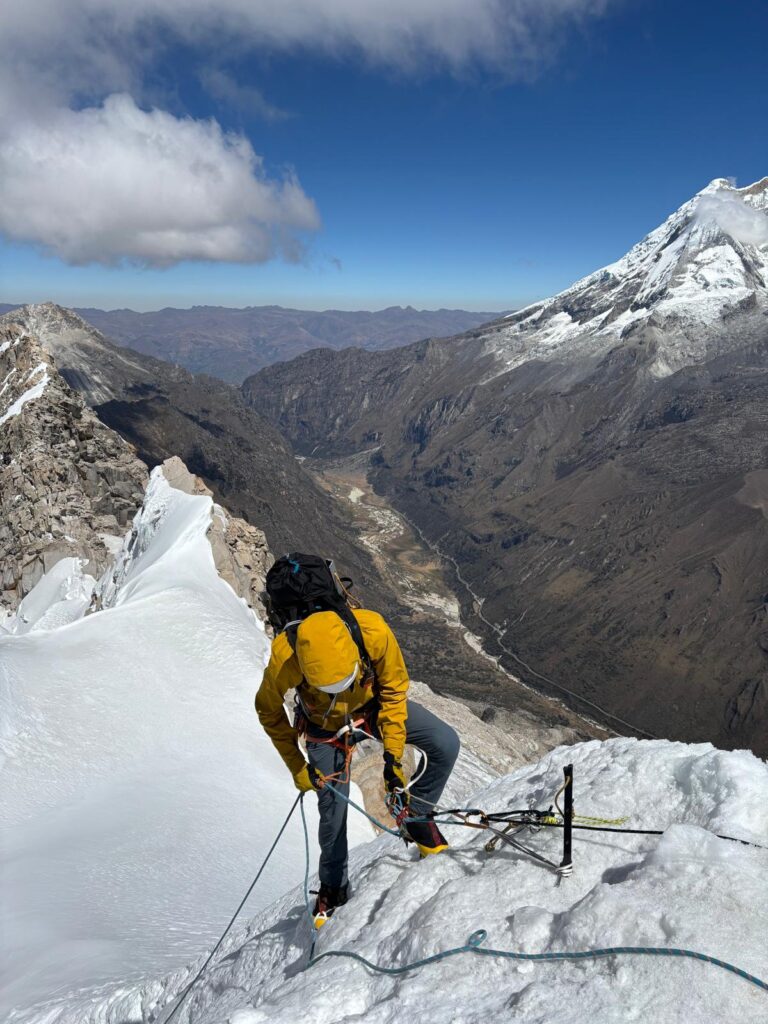
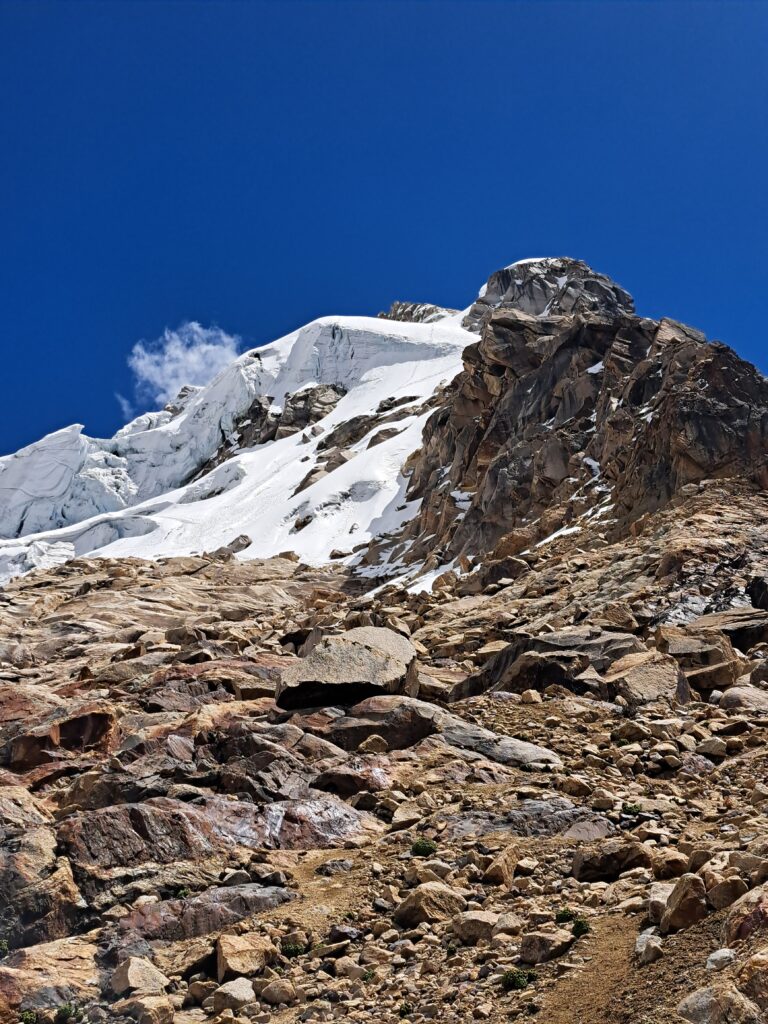
Expedition Cordillera Blanca, Peru
Climbing Expedition Report
Expedition Cordillera Blanca
Peru
July 19 / 20 – Travel Day from the Netherlands to Peru
This morning, my dad drove me to the airport at 6:30 a.m. It was time to fly out to meet the guys.
After passport control, I took my time walking to the gate and grabbed a cappuccino. Time went by pretty quickly. I had a little chat with a guy from Drenthe, and before I knew it, I was already up in the air.
On the plane, I ended up sitting between two Peruvian ladies. One of them lives in Germany, so luckily I was able to have a bit of a conversation with her. I also managed to make a deal with one of the flight attendants: a sandwich in exchange for a stroopwafel. You’ve got to do what you’ve got to do on a 12.5-hour flight.
Towards the end, we had to fasten our seatbelts again because of my beloved turbulence.
And then, finally, I had arrived in Peru!
Collecting my luggage and getting through passport control went smoothly, and I jumped into a taxi to my hotel in Lima. Because of the seven-hour time difference, it was only around 5:00 p.m., so I still had a few hours to fill. Going to bed that early didn’t seem like a great idea either.
So I decided to pick up a few groceries and take a stroll through the neighborhood. I bought a bag of tortilla chips and a few beers at a supermarket and walked back to the hotel.
A quick shower, some relaxing, and by 9:00 p.m. I was asleep.
Monday, July 20 – The Bus Ride to Huaraz
I wake up around 4:30 a.m. That time difference again.
But I had slept well enough, and I had plenty of time to drink some coffee and take things easy while getting ready for the day.
Plenty of time before I had to leave for the bus station. Or so you’d think.
The day before, I had asked the reception desk to arrange a taxi for me at 6:45 a.m. Breakfast starts at 6:30, so I figured I could quickly grab something to eat before leaving.
At 6:40, I was standing outside with my luggage, waiting for my ride. After waiting for ten minutes, I went back to reception to find out what was going on. They called the taxi company and told me the taxi would be there in another ten minutes.
This was going to be a race against the clock to make it onto the bus in time!
Luckily, the driver kept things moving, and just a few minutes before departure, I was standing in the terminal checking in for my bus ride. In the end, the bus left about twenty minutes later than scheduled, so I had actually had plenty of time.
I left Lima behind and headed inland. What a dry landscape! It looked almost like the surface of the moon.
After several hours of driving along the Pacific Ocean, the road started turning towards the mountains. The clouds began to clear and I could even see some vegetation growing in a riverbed.
It was pretty amazing to think that on the other side of these mountains lies the enormous Amazon rainforest.
There were also huge cacti growing on the mountain slopes. It looked like something straight out of a Western movie.
A little later, we stopped at a restaurant for lunch. Inside, there was quite a lot of chaos and shouting, probably because everyone was in a hurry.
I looked at the menu but didn’t recognize much of what was on it. So I played it safe and bought a banana and a sports drink. I’d have a proper meal once I got to Huaraz.
After the break, we continued deeper into the Andes, and little by little, the landscape began to change. It became greener, with more and more streams running through the valleys.
The bus climbed higher and higher along a mountain pass. The trees and shrubs gradually disappeared, replaced by open grassland.
We were driving above 4,000 meters. For me, that was actually a pretty easy way to start acclimatizing.
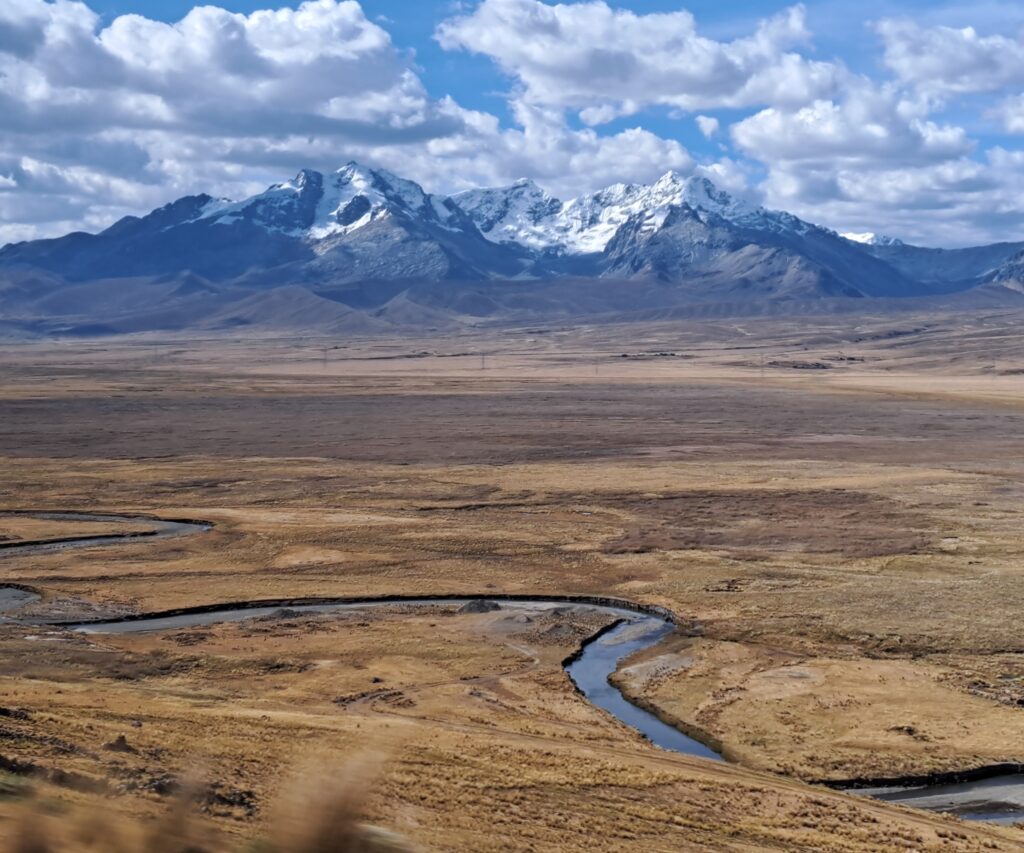
And then, suddenly, the snow-covered peaks appeared.
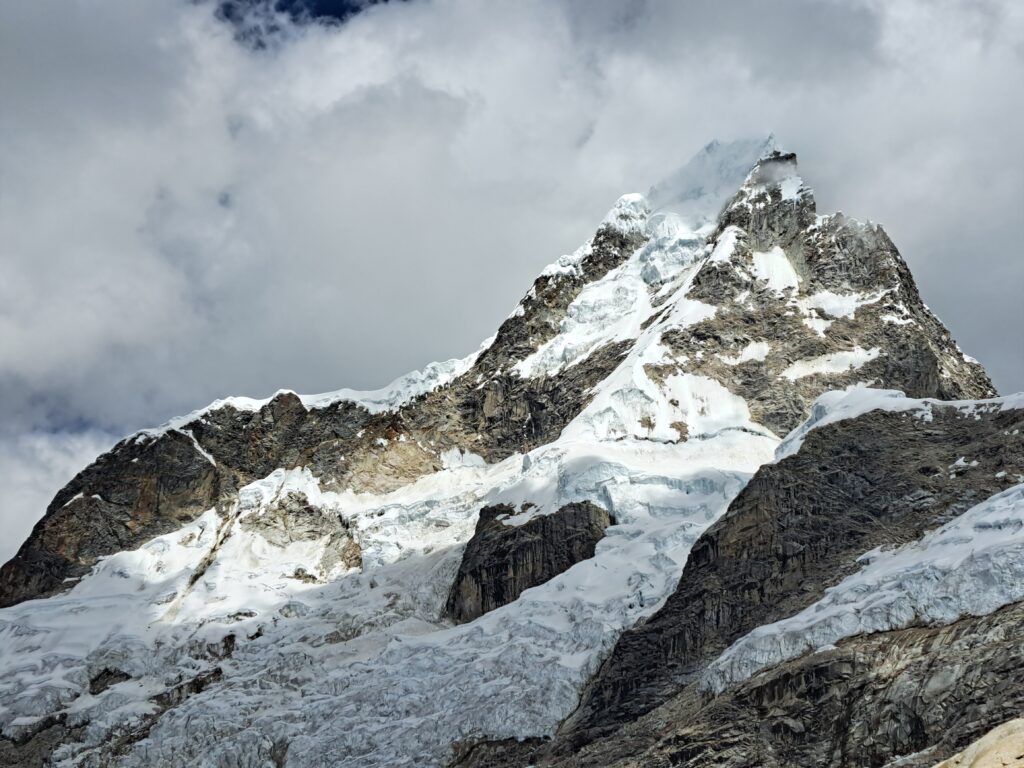
First I spotted Nevado Pastoruri, followed by Huarapasca. In the distance, I could also see Huascarán, rising to more than 6,700 meters.
What mountains!
What incredibly steep ice walls!
For the final part of the journey, I did nothing but stare out of the window.
By the time I reached Huaraz, it was incredibly busy, and that last stretch seemed to take forever. I just wanted to get off the bus.
Eventually, I arrived at the station and I saw the guys waiting for me. I stepped off the bus and we greeted each other.
It felt so good to finally be there after everything I had been through over the previous period.
We walked to the apartment, unpacked our luggage and sat down for some tea.
Because I arrived later than planned, our original plans were off the table. On top of that, Huascarán, the highest mountain in Peru, was closed following a fatal accident involving three climbers.
Luckily, Chris and Rogier had already come up with plenty of other options. Over the next few days, we’d figure out some good objectives.
There are so many mountains to climb here.
But first, I needed to make sure I acclimatized properly. As soon as I stepped off the bus, I could tell I was no longer at sea level. Huaraz sits at 3,100 meters, and I could definitely feel it in my breathing.
Even walking up the stairs to the apartment took a little more effort than it would have at home.
After tea and a shower, we went out for dinner at a little burger place. That’s when I slowly started feeling tired.
Jet lag doesn’t disappear in a single day.
After dinner, I quickly headed to bed and was out like a light.
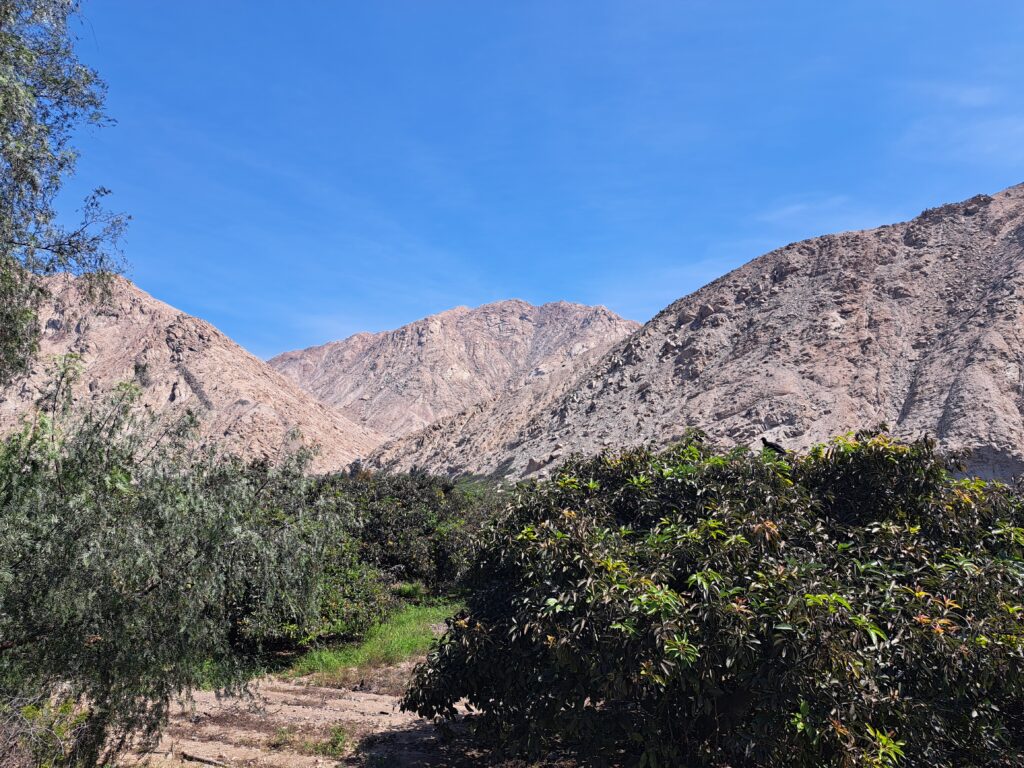
July 21 - Hiking and acclimatizing at Laguna Churup
After a restless night, I wake up at 3:30 a.m. The jet lag is still very much alive and kicking. I try to get back to sleep, but eventually give up. Time to get up.
Today, we’re heading out for a hike to Laguna Churup, a beautiful mountain lake sitting at around 4,450 meters. The plan is to get as high as we can, giving me a good opportunity to start acclimatizing properly.
But first things first: coffee.
A little while later, the guys emerge from their bedrooms and we sit down for breakfast. At 7:00 a.m., our taxi arrives to take us to the trailhead.
After about an hour on the road, we arrive at the starting point. We arrange a pickup time for later and set off.
We’re starting at around 3,750 meters, so we agree to take it easy. Going all-out at this altitude definitely isn’t the smartest move. Instead, we settle into a comfortable pace and slowly make our way uphill.
The sun is shining, the weather is perfect, and we’re hiking in shorts as we steadily gain elevation.
Before long, we’ve passed the 4,000-meter mark. I’m honestly amazed at how well I seem to be handling the altitude. Everything feels surprisingly easy.
At around 4,500 meters, we reach Laguna Churup and stop for a break.
And what a place!
The lake is an incredible deep blue, surrounded by rugged mountains, with the roughly 5,400-meter Cerro Churup rising dramatically behind it. The scenery is absolutely stunning.
We decide to push a little higher and continue towards Laguna Churupito, a smaller lake sitting at around 4,600 meters. It’s a perfect excuse to gain a little more altitude and get some extra acclimatization in.
And I still feel fantastic.
It’s pretty crazy to think that just two days ago I was at sea level, and now I’m standing at 4,600 meters without any real problems.
We spend some time studying the mountain and trying to figure out a possible route. We spot what looks like a logical line along the ridge on the right-hand side. We decide to do some proper research back at the apartment later and see if we can figure out whether it’s actually a viable route.
For now, though, it’s time to head back down.
We make our way back to the pickup point, joking and messing around the entire way. There’s never a dull moment with this group, and the laughs just keep coming.
Eventually, we reach the bottom and our taxi takes us back to Huaraz.
Back at the apartment, we get straight into research mode. We start looking at the different mountains in the area, checking out routes, elevations and climbing possibilities. Before long, we’re already making plans and dreaming up our next adventure.
Unfortunately, we also discover that the effects of El Niño are having a significant impact on the current mountain conditions. Some of the routes are in much worse shape than we had hoped, making certain climbs considerably more difficult — or simply not worth attempting right now.
Still, there are plenty of options to explore. We spend the afternoon looking at different mountains and routes, trying to figure out what our best options are for the days ahead.
After all that planning and researching, we decide it’s time for something a little less demanding: pizza.
With full stomachs and plenty of ideas for the days ahead, we call it a night and head to bed early.
Tomorrow, another day in the mountains awaits.
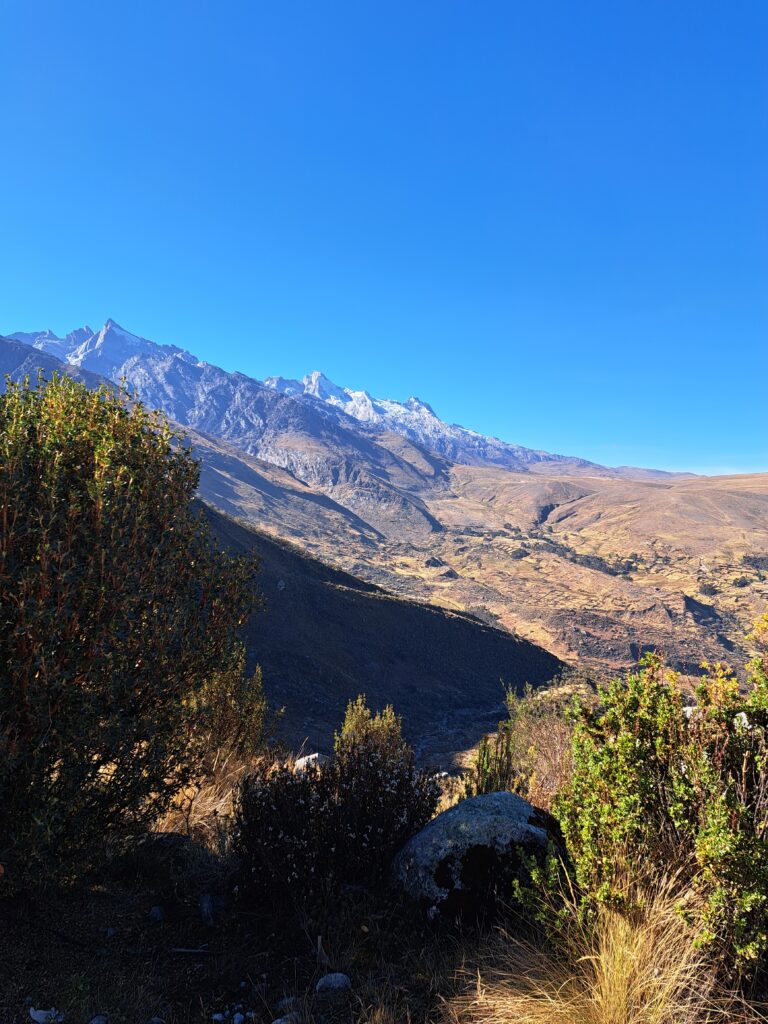
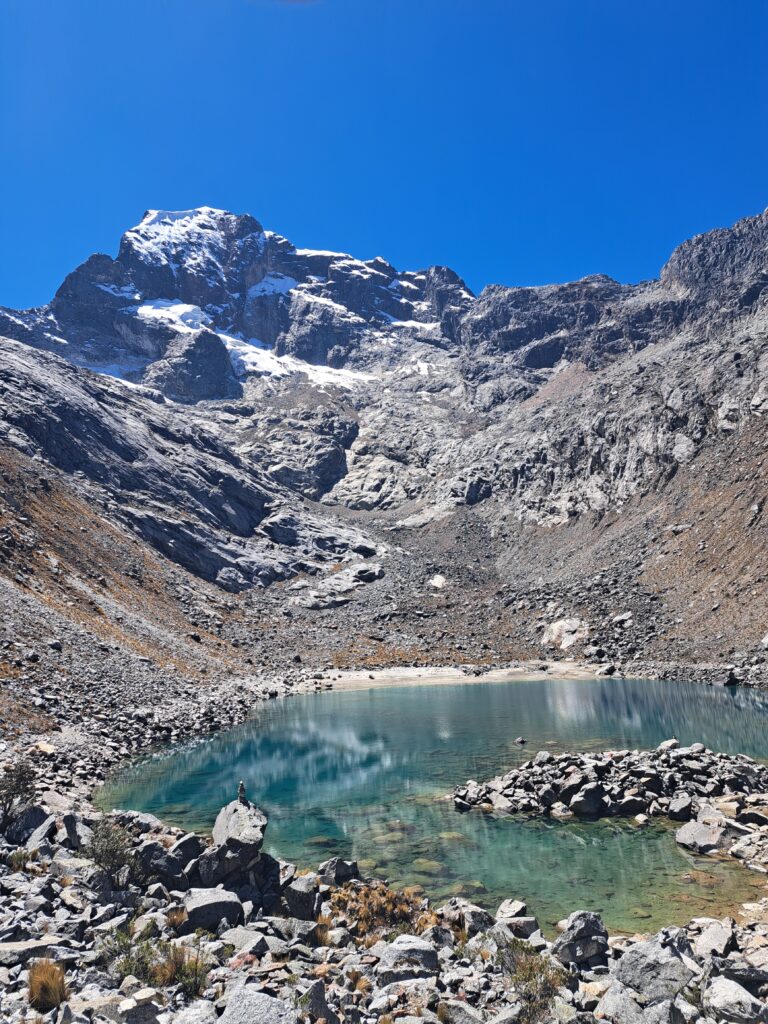
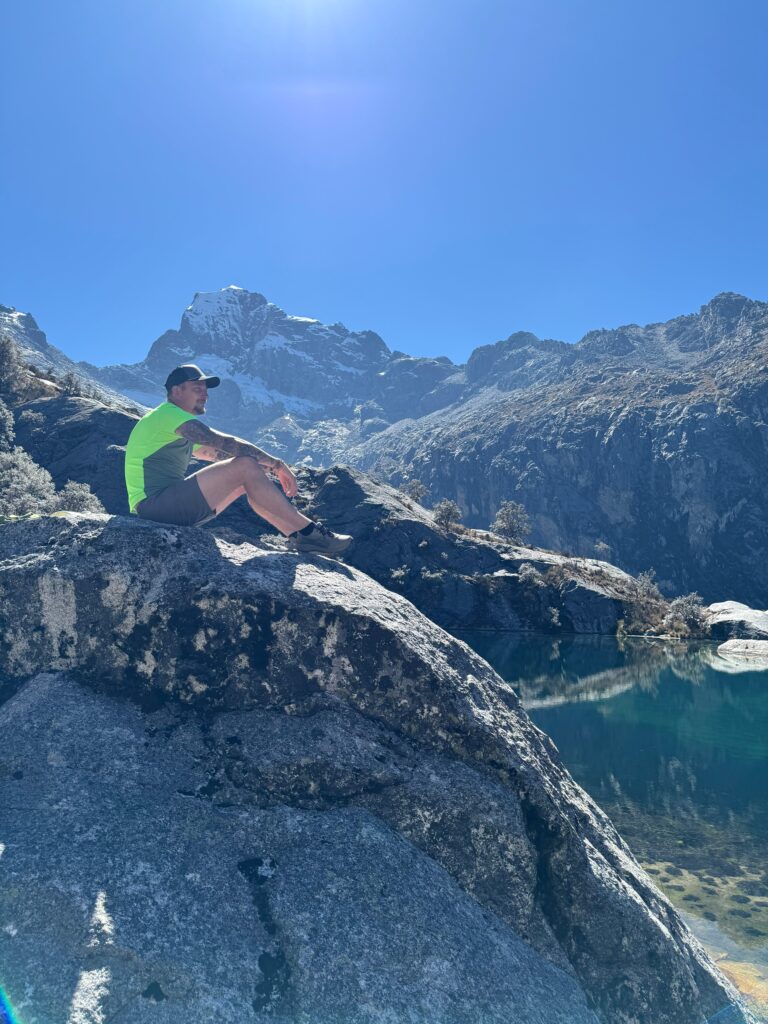
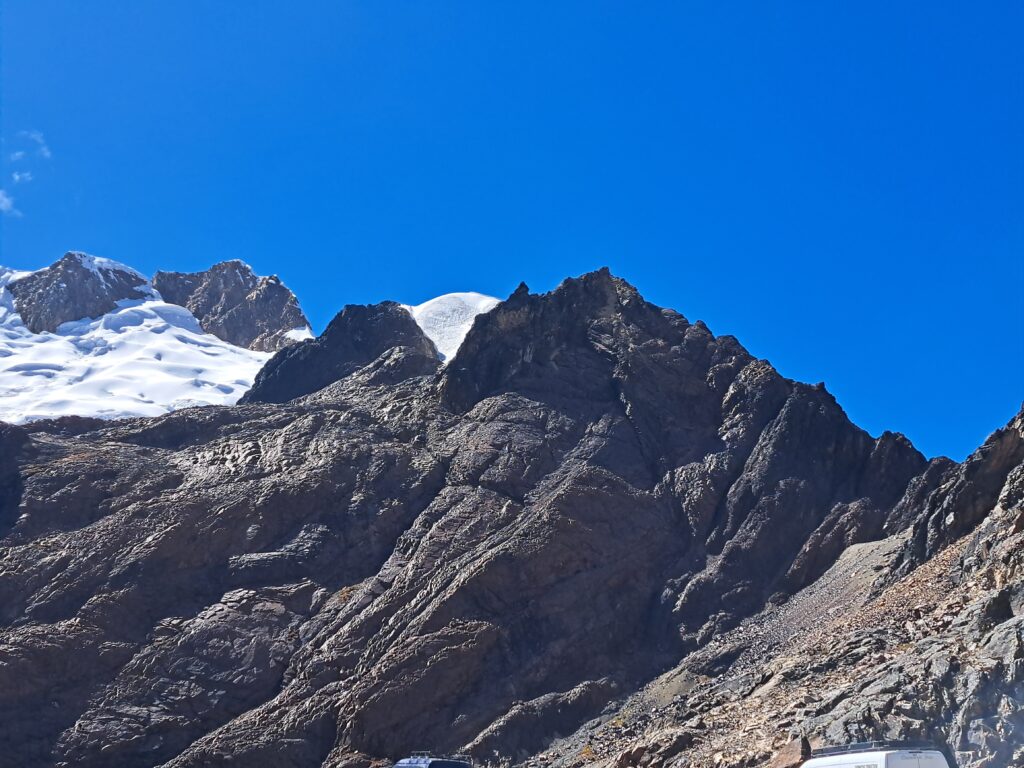
The ascent of Nevado Mateo, an ideal 5,250-meter peak for acclimatizing to the altitude.
Unfortunately, I woke up again at 2:30 this morning. Apparently, the good nights of sleep are still on vacation somewhere else. Luckily, the time difference has its advantages too: at this hour, I can conveniently call home for a bit.
Not long after, Chris and Rogier are also in the living room and we quickly grab some breakfast. Our driver is picking us up at 4:00, so there’s no time for an elaborate breakfast. With half-closed eyes, we throw our gear into the car and start the two-hour drive towards the mountain.
At 6:00, we arrive at the foot of the mountain. The sun has only just woken up and is slowly starting to spread some light across the mountains. We’re a little more awake by now and get ready for the climb. Bags packed, gear checked, and mostly trying to remember what exactly we need to bring.
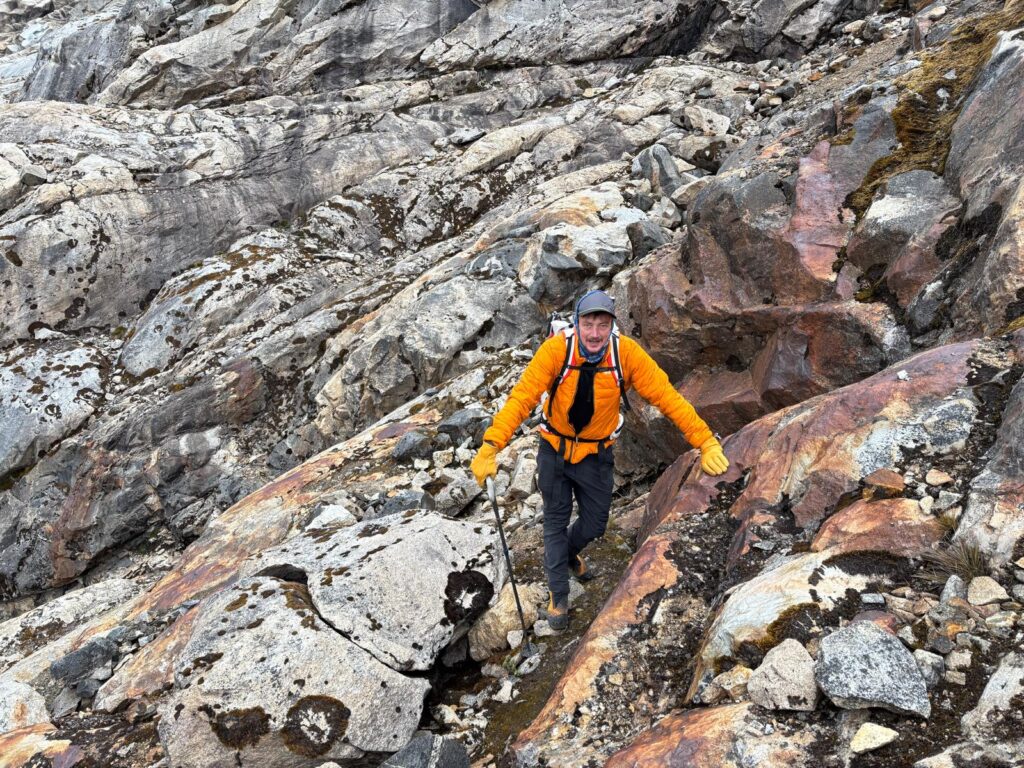
The first section is thankfully still an actual hiking trail. That doesn’t last long, though. Before we know it, the trail turns into a natural obstacle course and we’re mostly scrambling over rocks. Along the way, we quickly overtake a few rope teams. Quite impressive, considering that, from our perspective, we’re definitely moving at a leisurely pace.
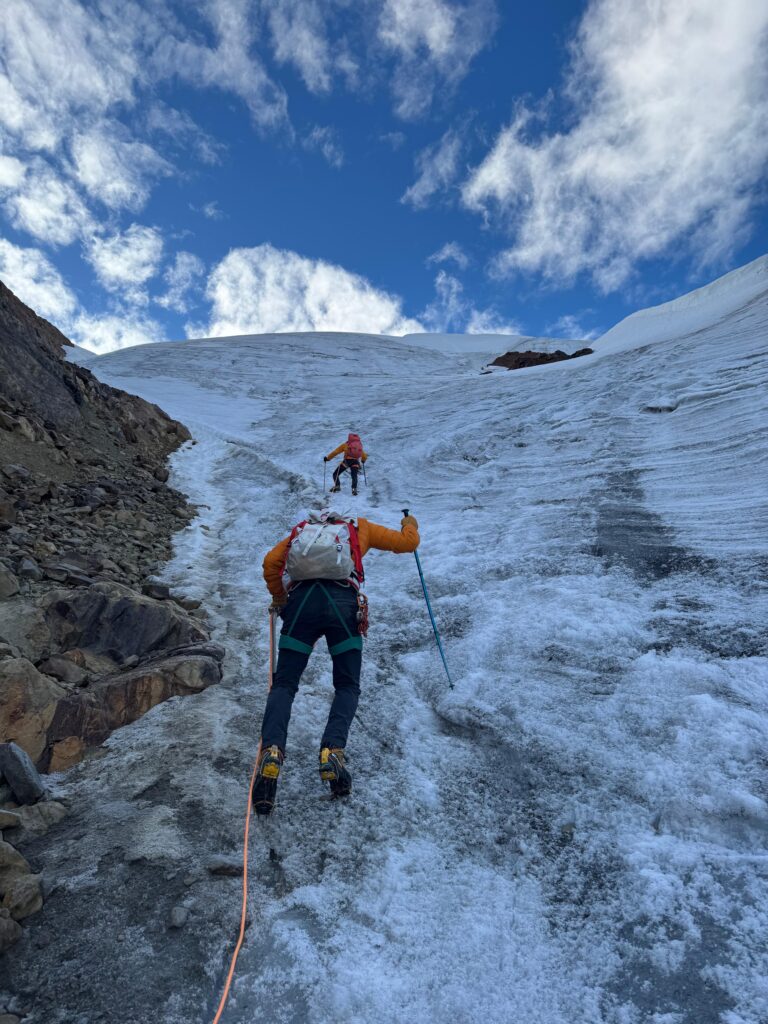
After about an hour, we reach the foot of the glacier. Time for a short break. Harnesses on, crampons under our boots, and some food to keep the engine running. We also discuss the order of the team. Who wants to go first? Who goes at the back? And who gets the questionable honor of walking in the middle?
Rogier is unanimously appointed our great leader and gets to lead the way. Chris isn’t particularly keen on being in the middle, which means I apparently become the perfect candidate. Fine by me. I couldn’t really come up with a good excuse anyway.
The lower section of the glacier is quite steep and, above all, very icy. Every step requires a little bit of attention to make sure you place your crampon properly. Luckily, the snow conditions improve as we get higher, allowing us to pick up the pace a little.
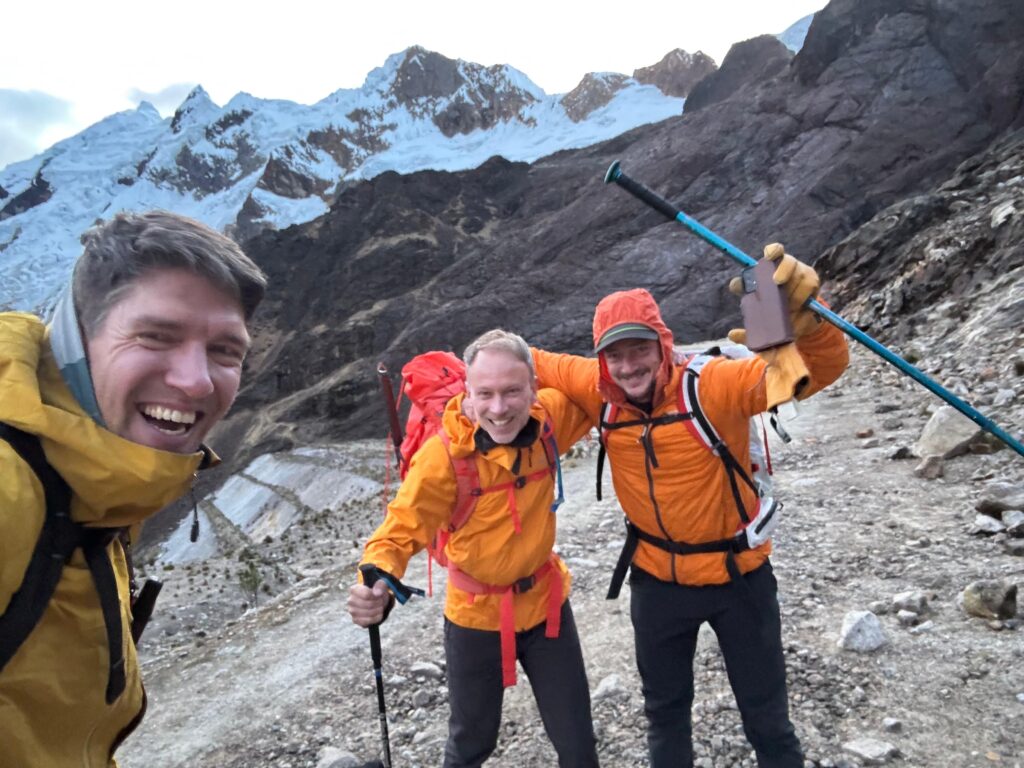
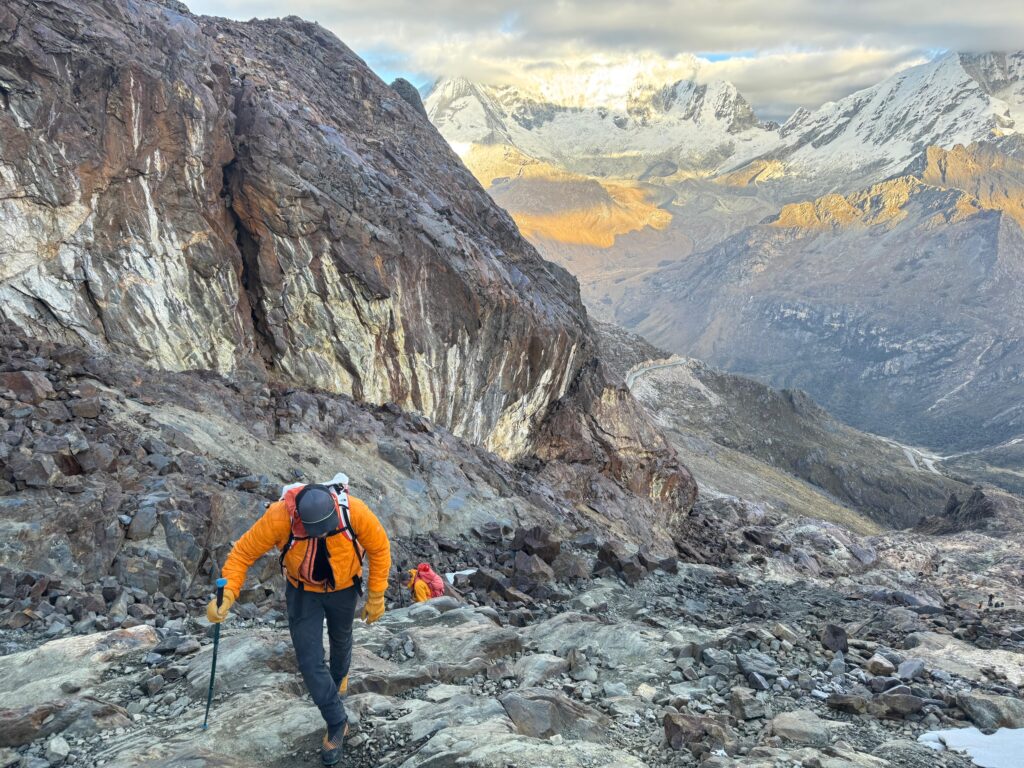
And then, suddenly, we hear Rogier’s voice:
“We’re almost at the top!”
Chris and I look at each other and start laughing. Seriously? Already?
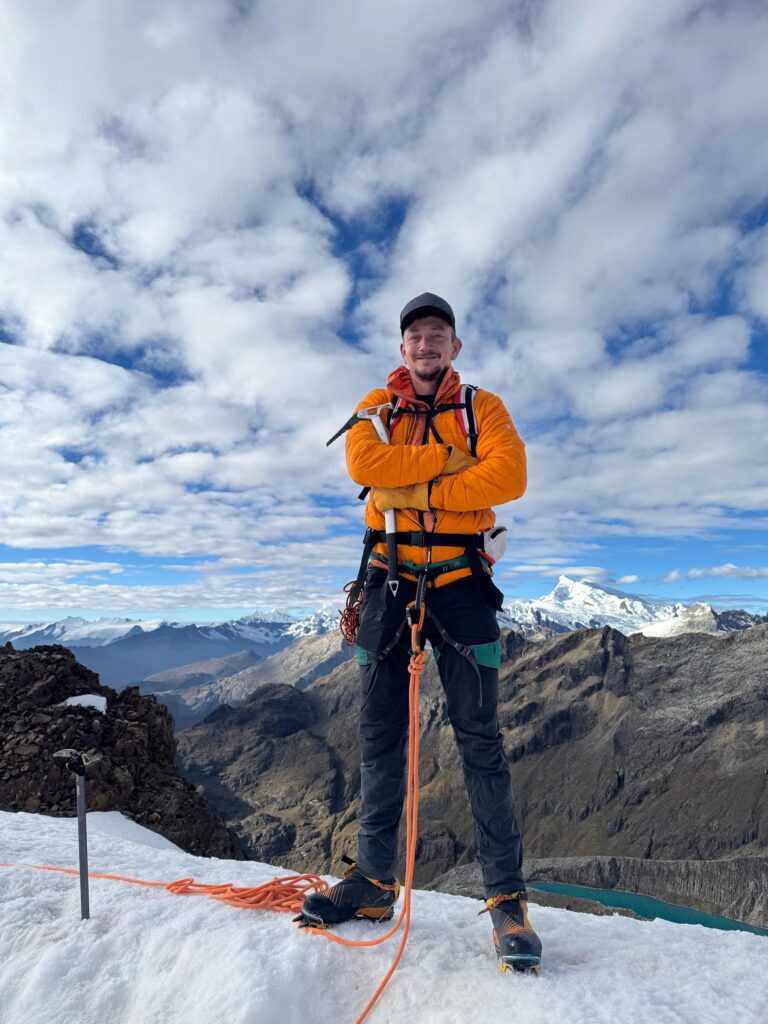
We had mentally prepared ourselves for a proper climb, but this mountain turns out to be more of an excellent introduction. A short 5,000-meter peak. Perfect for acclimatizing, testing our gear, and getting a feel for the snow conditions. And of course, it’s a nice bonus that we don’t reach the summit completely destroyed.
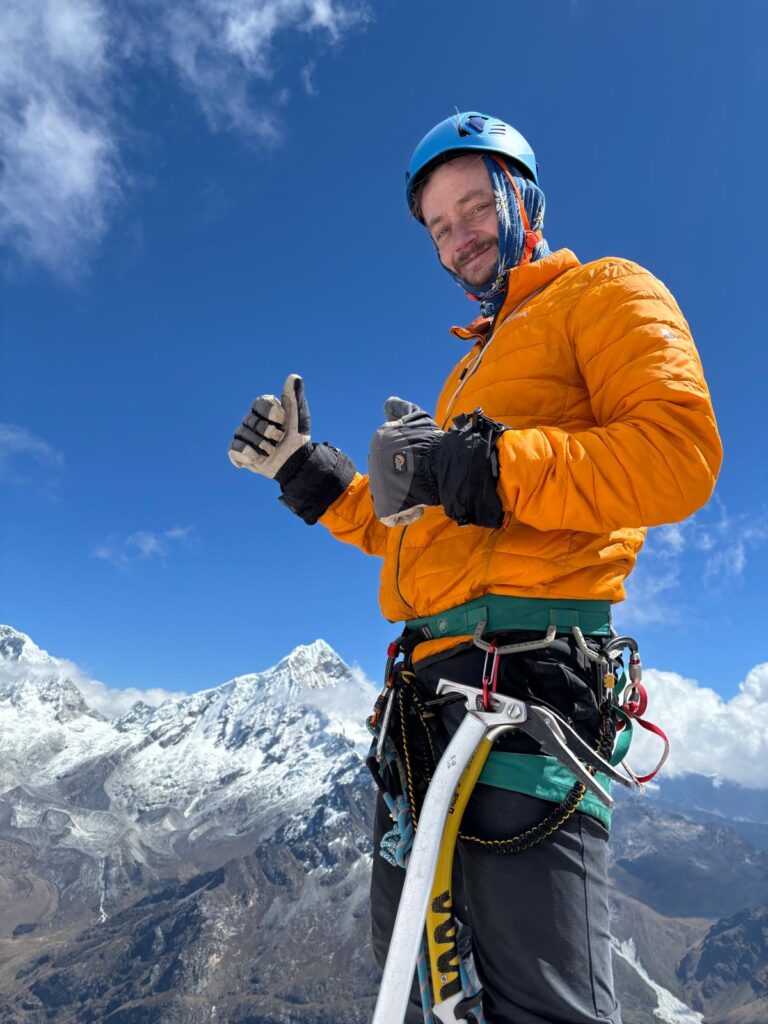
So we take our time at the top. We take plenty of photos and videos, admire the incredible landscape, and study the neighboring mountain. Maybe there’s a nice route up that one too. In the meantime, we mostly enjoy the view and the fact that the three of us are actually standing on top of a 5,000-meter peak.
But, as always, the party eventually has to end. It’s time to head back down.
We decide to descend the glacier without a rope. There are no crevasses, the slope is manageable, and there are quite a few other rope teams coming up. Without a rope, it’s easier to move around and between the other climbers.
The descent goes smoothly, and before long we’re back on the rocks. Crampons off, harnesses off, and all the climbing gear goes back into our bags. Then we tackle the final section down over the rocks. Before we know it, we’re back at the car.
The first 5,000er is in the bag!
And honestly, it makes us want more.
After the two-hour drive back, we decide to take it easy for the rest of the afternoon. We have a nice meal at a little restaurant and talk about the climb. And, of course, the now-legendary “special” Peruvian music comes up in conversation several times.
Some things you simply never forget.
Luckily. Or perhaps unfortunately.
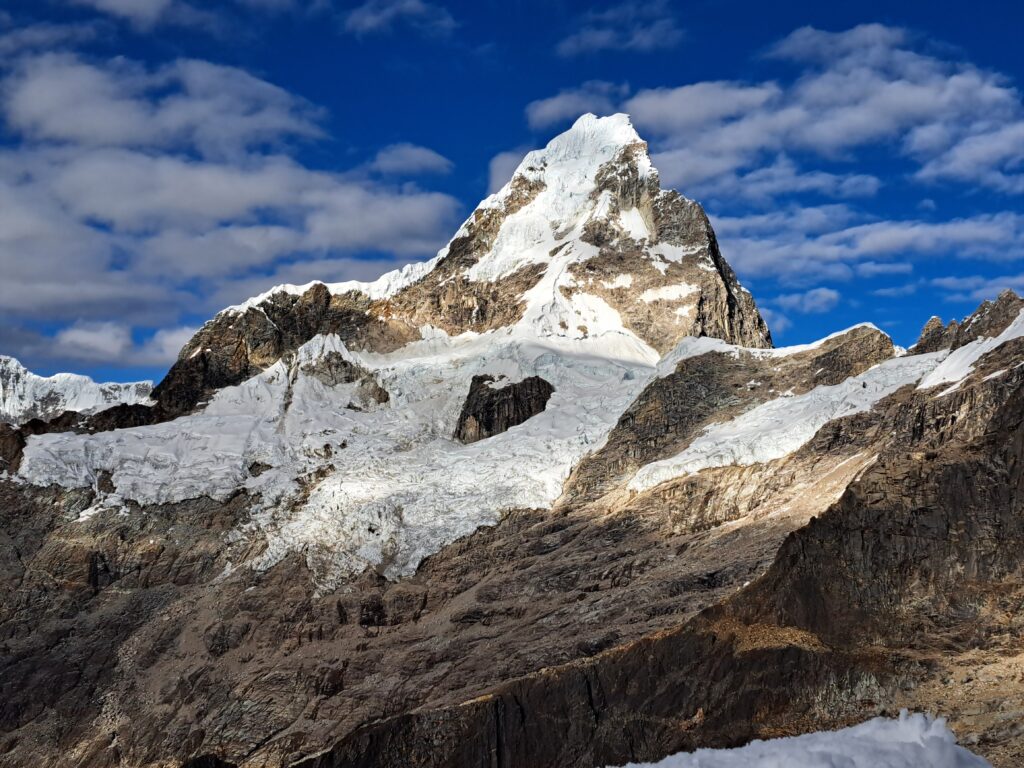
July 23 - Yanapaccha Bacecamp, my first night at high altitude
This morning I get up after finally having a good night’s sleep. Almost eight hours — wonderful!
A little later, when Rogier and Chris get out of bed, they tell me they slept well too. We spend the morning in the apartment preparing our gear, eating, relaxing, and going over tomorrow’s route.
At 11:30 a.m., our regular taxi company picks us up and we head towards Yanapaccha Base Camp. Our plan is to climb the West Face Direct.
The road to Base Camp is, to put it mildly, quite something. As soon as we leave Huaraz, the asphalt disappears. For about two hours, we drive along dusty, rocky roads. And to think that this is actually a through road to the other side of the mountains.
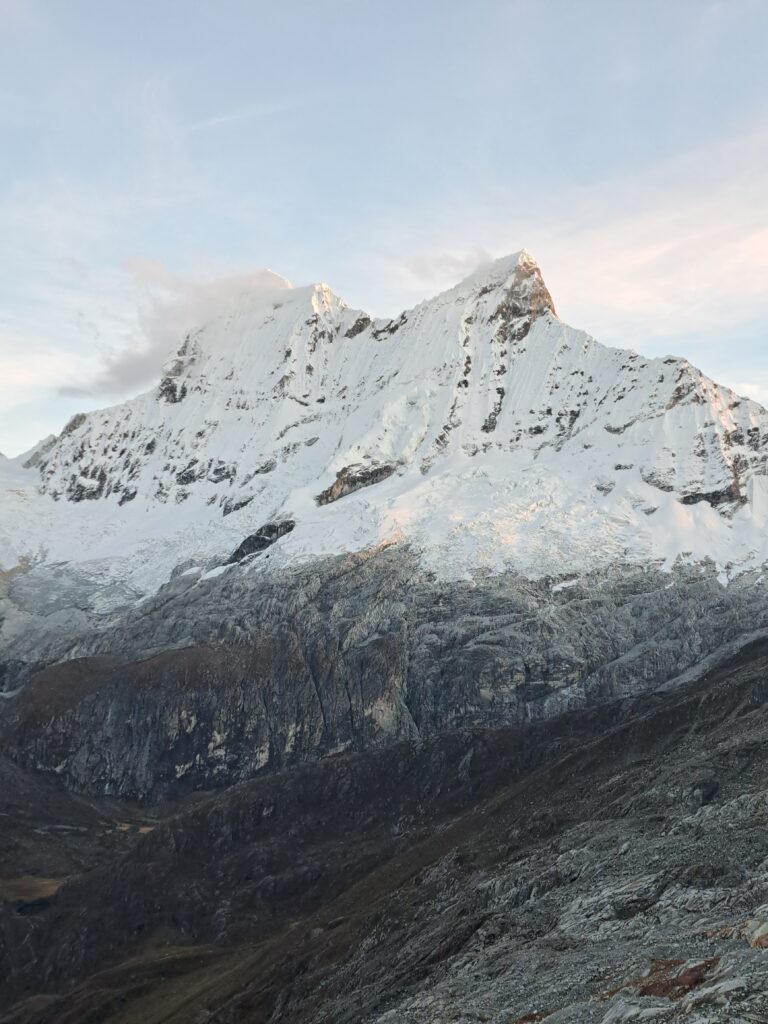
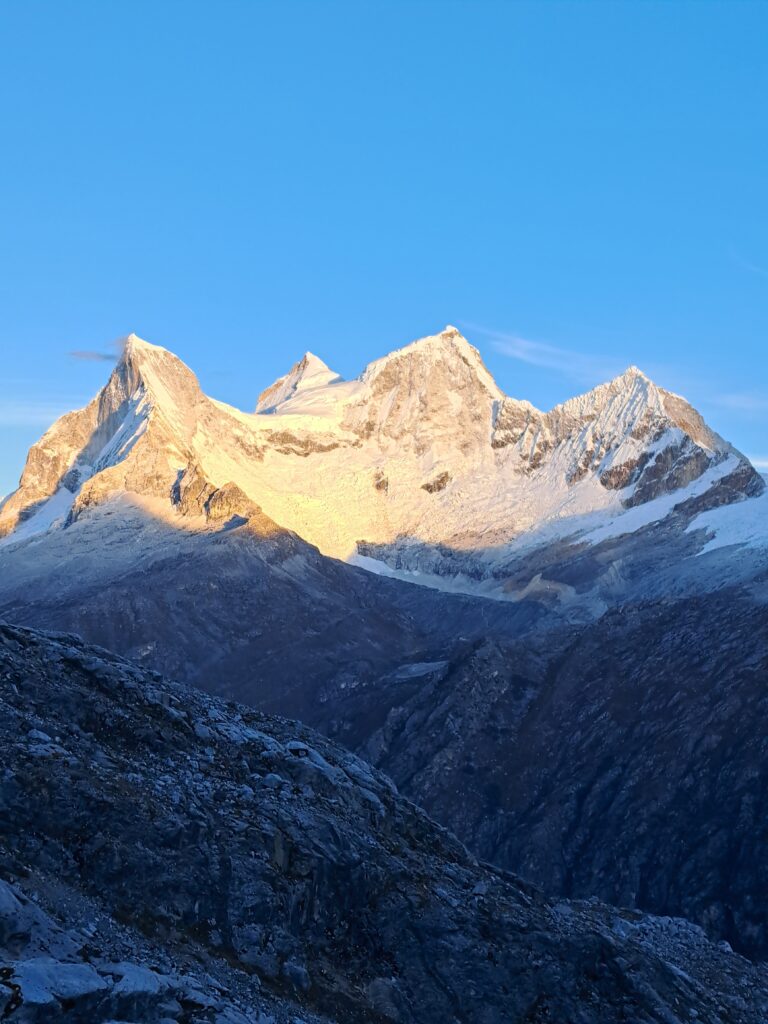
Once we enter the valley, the scenery becomes incredible. We drive past the three peaks of Huandoy, past Chopicalqui and also past Nevado Pisco, our objective in three days.
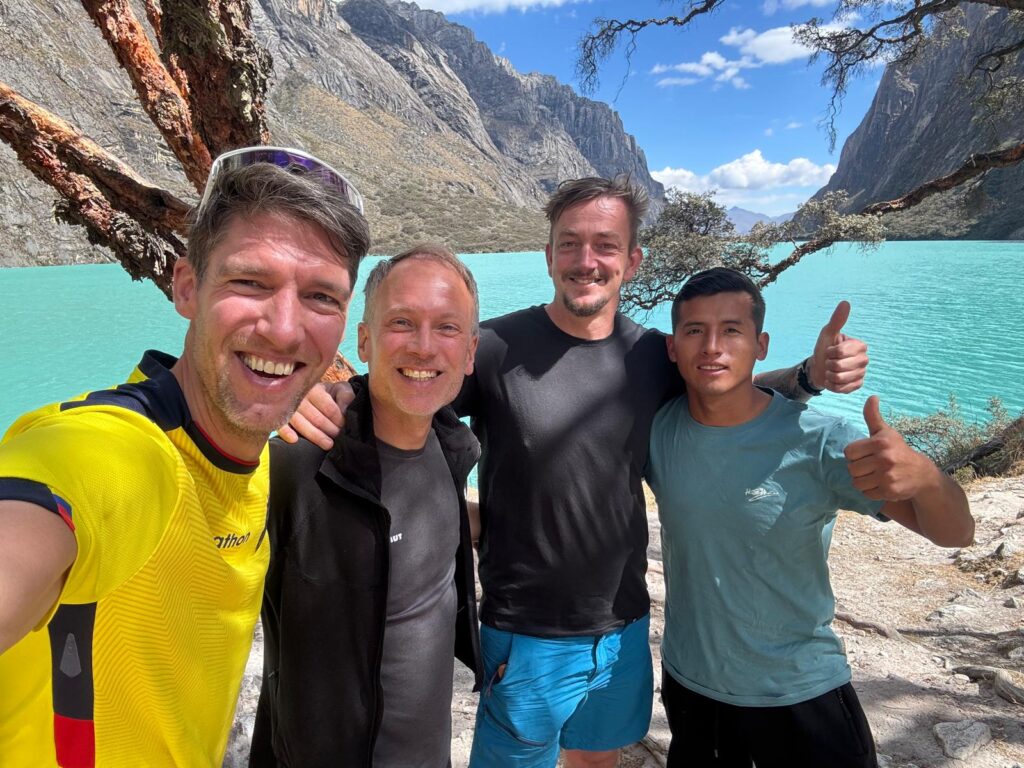
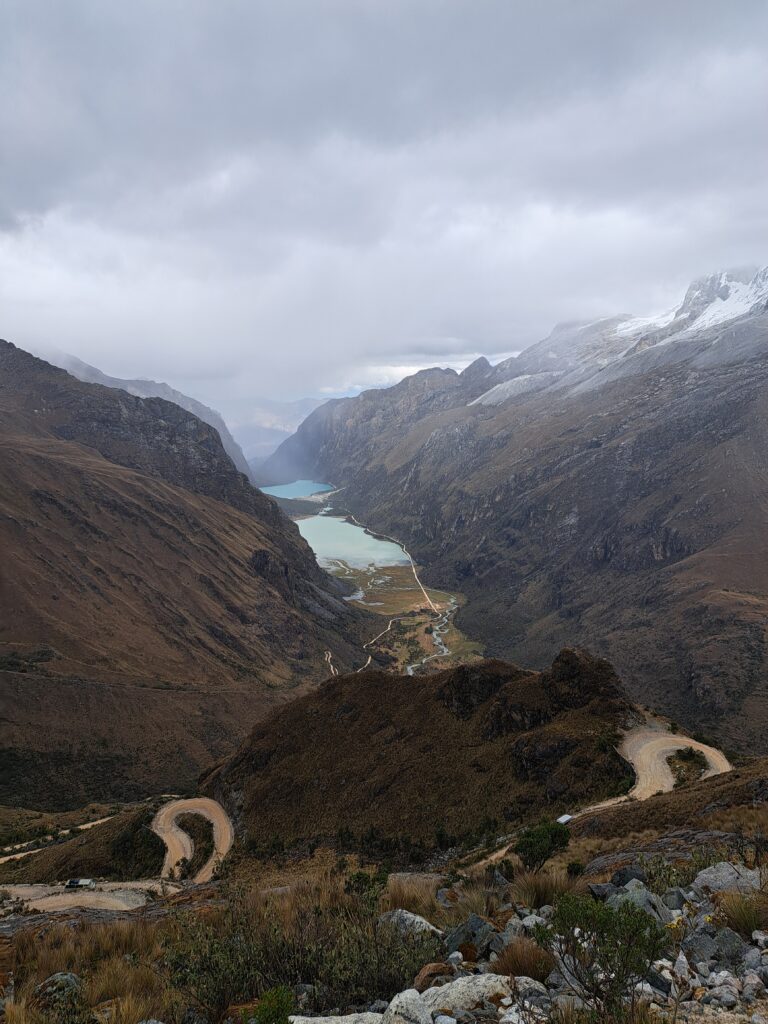
We also drive past a turquoise lake. I’ve never seen water with a color like that before.
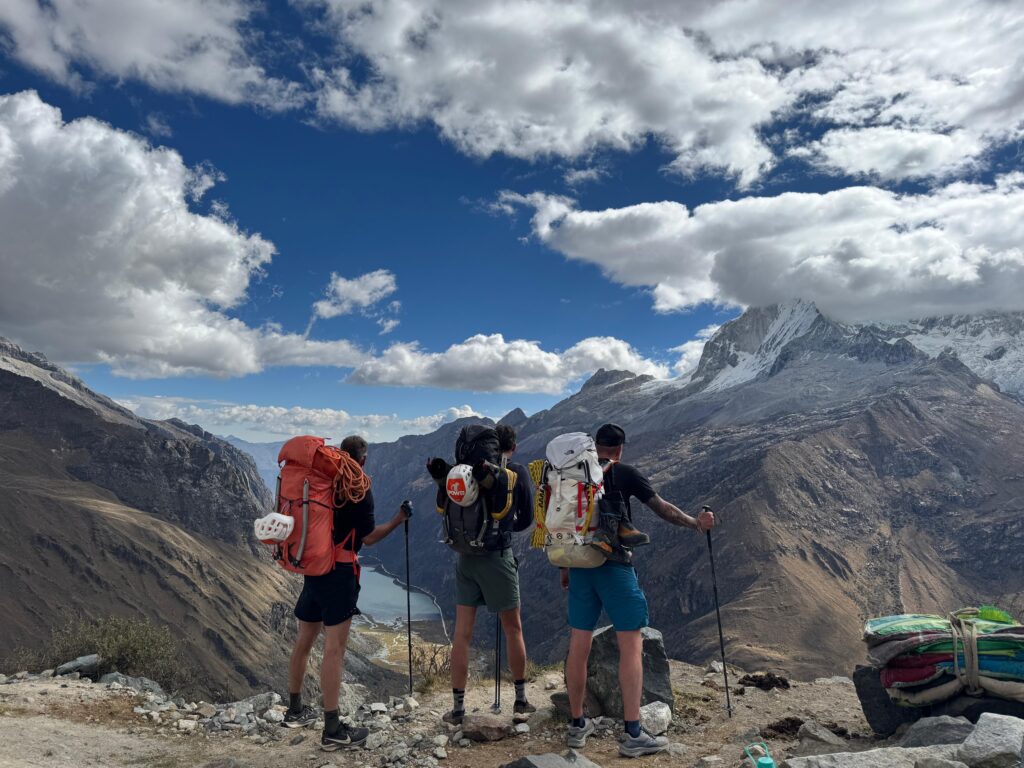
After the lake, we continue climbing to 4,600 meters, where we start our hike to Base Camp. We weave our way around a few donkeys and head deeper into the valley.
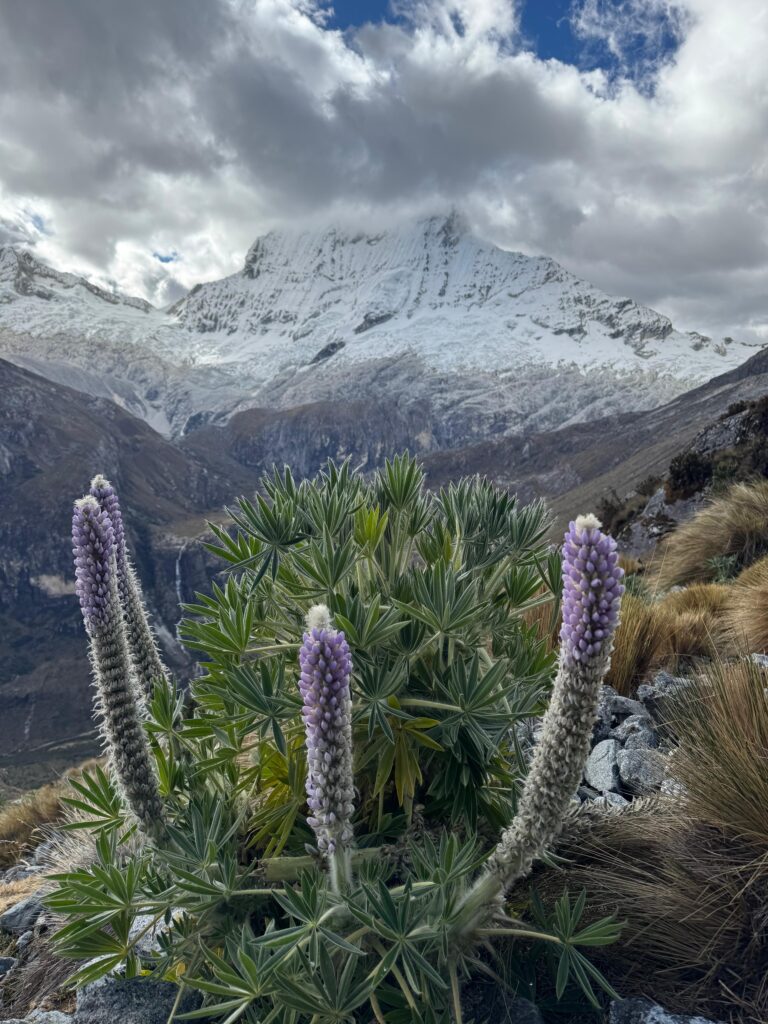
Along the way, we come across a beautiful species of flower that grows here in the high mountains. Unfortunately, we don’t know what it’s called.
We’re also carrying a seven-liter container of water. Wilco van Rooijen and Cas van de Gevel warned me that you can get seriously sick from drinking mountain water, because animals also come this high. Their droppings can contaminate the water.
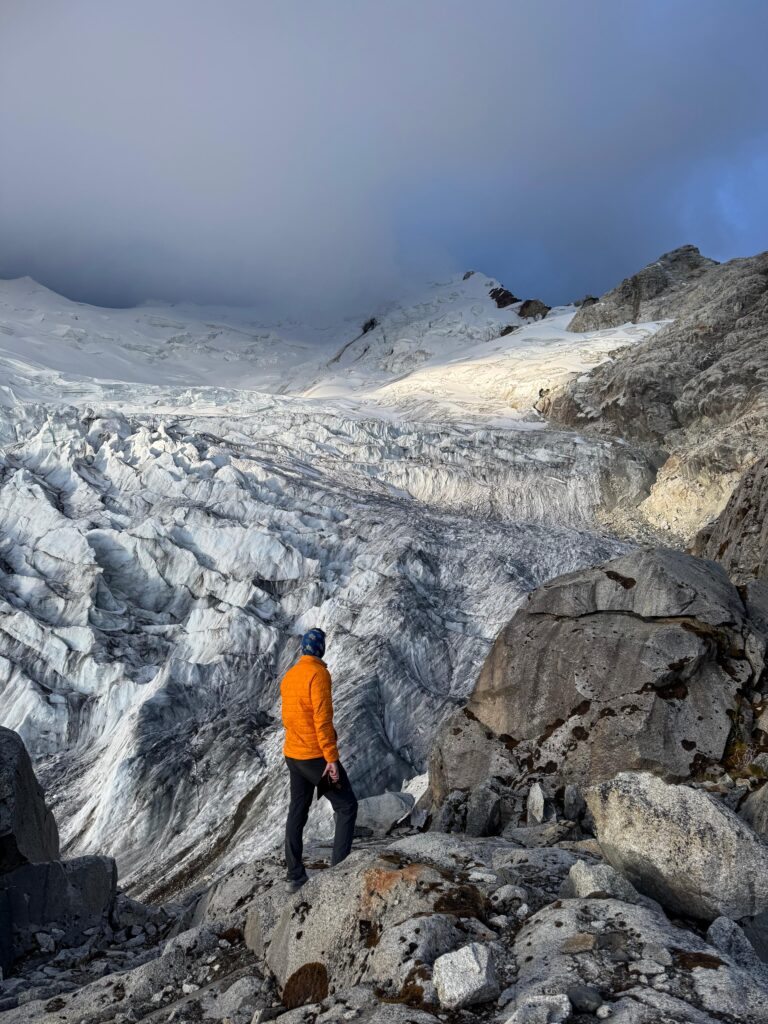
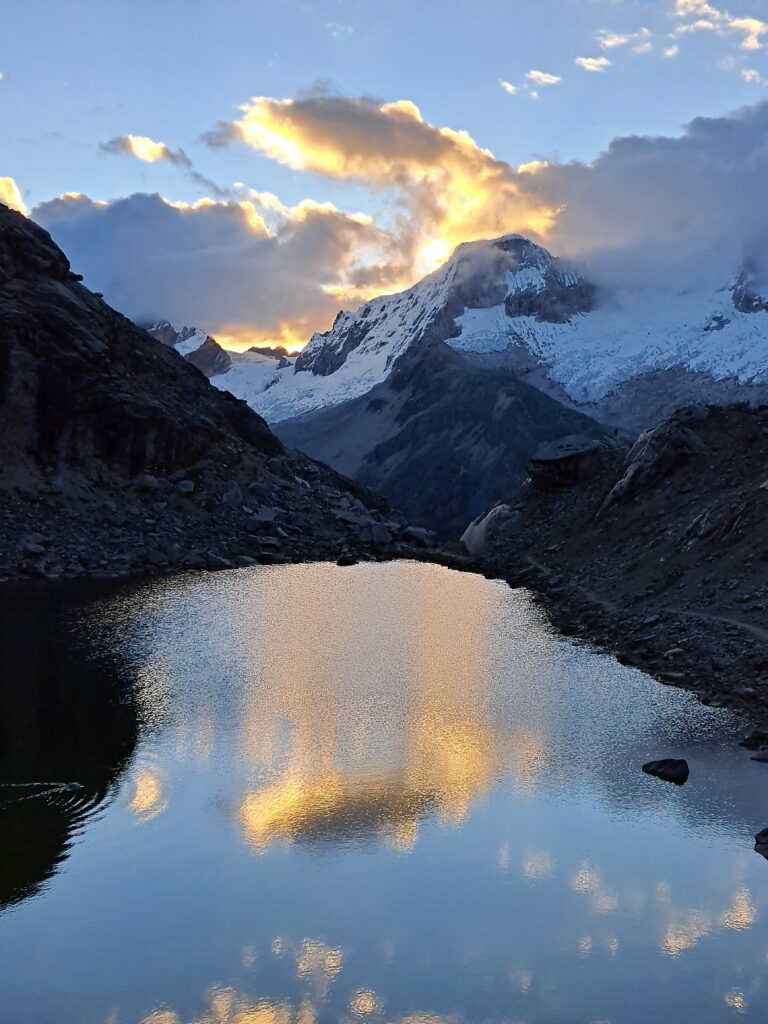
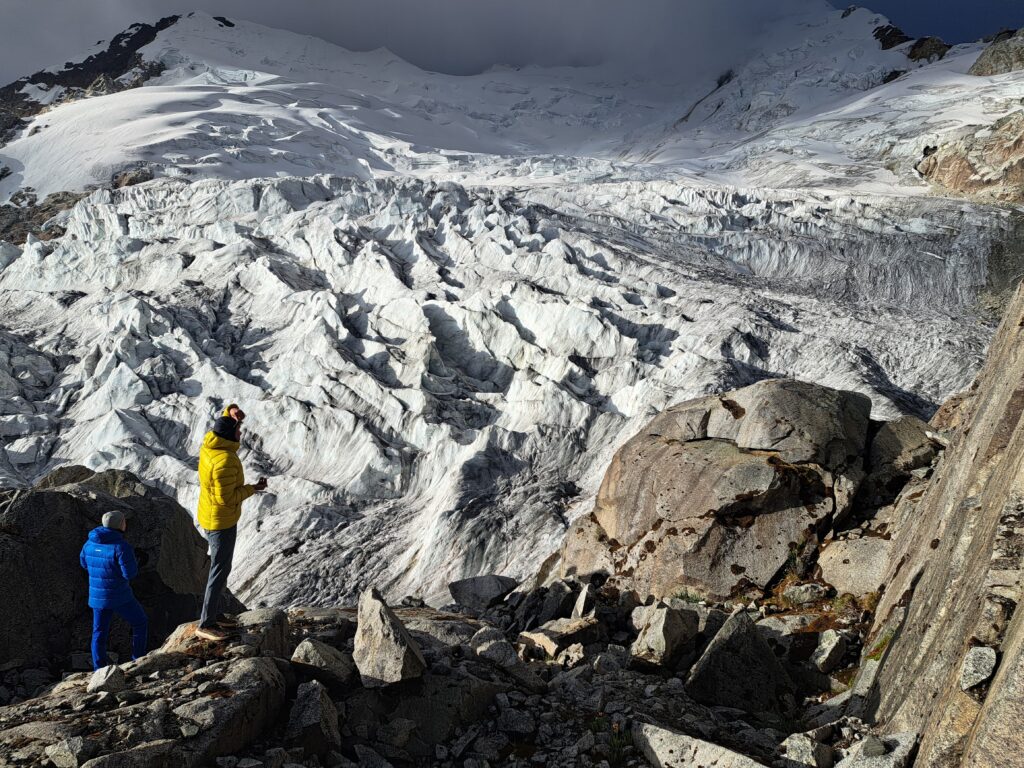
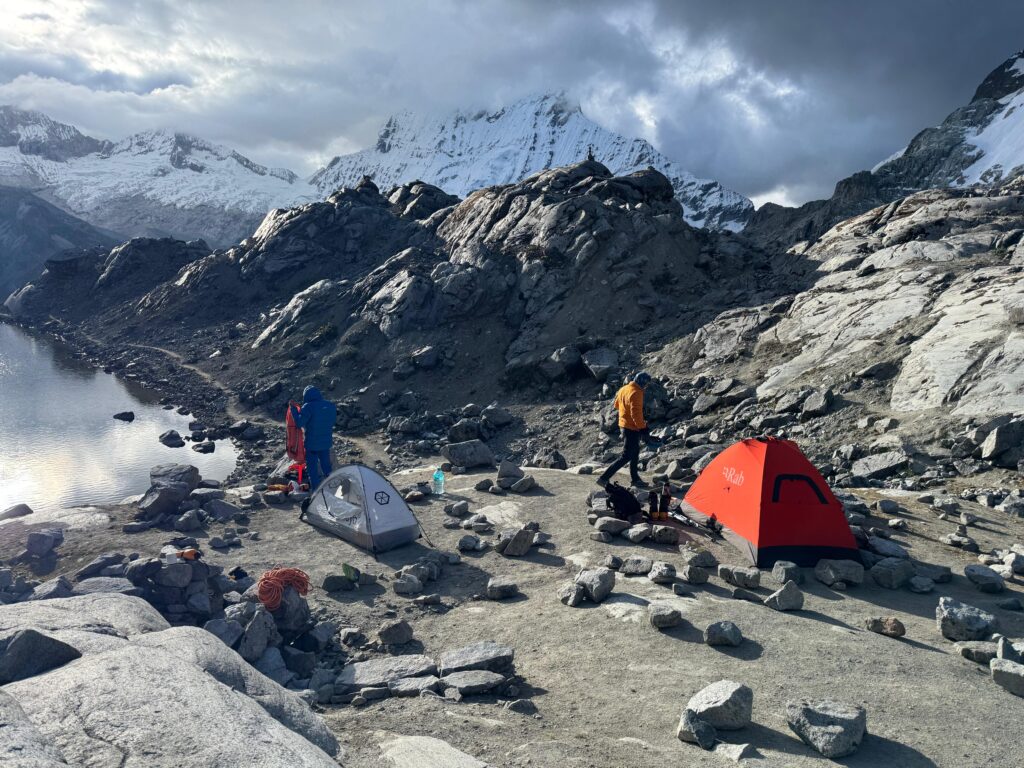
Along the way, we wonder whether it’s really necessary to haul all that water up to 4,800 meters. But once we reach Base Camp, we’re very happy to have it with us. There’s no running water here, only a small lake.
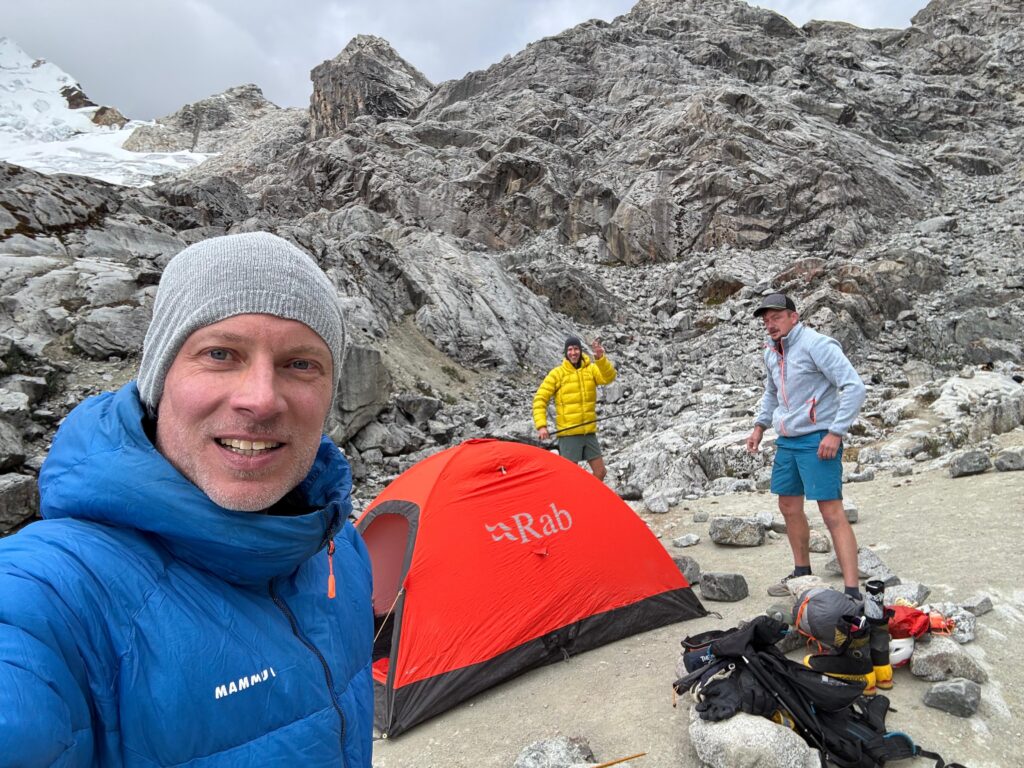
We set up our tents, scout the route, and prepare our food. Since it’s winter here, it gets dark early, so we quickly crawl into our sleeping bags.
I soon feel the fatigue kicking in and fall asleep like a log.
July 24 – A day to forget quickly
I wake up at 3 a.m. and immediately know something is wrong. A pounding headache and dizziness. The jump from spending several nights at 3,100 meters to 4,800 meters has simply been too much. It often goes well, but unfortunately, this time it doesn’t.
I let Chris and Rogier know. They’re unsure what to do. I tell them they really need to go up. As long as I stay at this altitude, I’m not too worried about things getting worse.
After a long discussion, they decide to go. They choose to take the normal route rather than the face, so they can get back more quickly.
What absolute legends they are!
I crawl back into the tent while the guys head towards the mountain. I fall asleep again and don’t wake up until around 6:30.
When I get up, I’m fortunately feeling a little better already. I drink some tea, scan the mountain hoping to spot the guys, and spend some time reading and writing.
A little later, the sun comes out and I walk towards the lake. I wait there for the return of ‘Team Hollandia’ and think about what to do next.
Unfortunately, more and more clouds start moving into the valley and it becomes freezing cold. I quickly head back to the tent.
What a horrible day.
I was already behind in the acclimatization process, and of course this has only made things worse. I really hate it when people can’t do what they want because of me and have to adjust their plans around me. I’ll have a proper talk with them later.
Around 9:15 a.m., they return. They’ve just had an amazing climb, and I’m incredibly happy for them.
We make something to eat at Base Camp and then pack up our gear.
Time to head back to Huaraz.
As usual, we have a great time on the way back, joking around and giving each other a hard time. Once we arrive back in Huaraz, it’s raining.
Time to put this day behind us.
July 26 - Huarapasca, the mountain that will remain a memory forever
After taking a rest day yesterday, today we are set to climb Huarapasca, a 5,420-meter-high mountain.
We want to climb this mountain in a single day. At 2:15 a.m. the alarm goes off and we quickly eat something. Then we head downstairs, jump into our taxi and drive south.
At 5:15 a.m., after yet another remarkable drive, we arrive at the mountain. We unload our gear from the car and start walking. It takes about an hour to reach the foot of the mountain, which is also the crux of the climb.
When we arrive, there is another climber there, on his own. We start talking to him and it turns out that his climbing partner is sick. We invite him to climb with us. Climbing a technical route like this alone simply isn’t a sensible thing to do.
We form two rope teams, and I rope up with our new Argentine friend, Alejandro. Chris and Rogier start first on the ice wall. A little later, Alejandro and I follow.
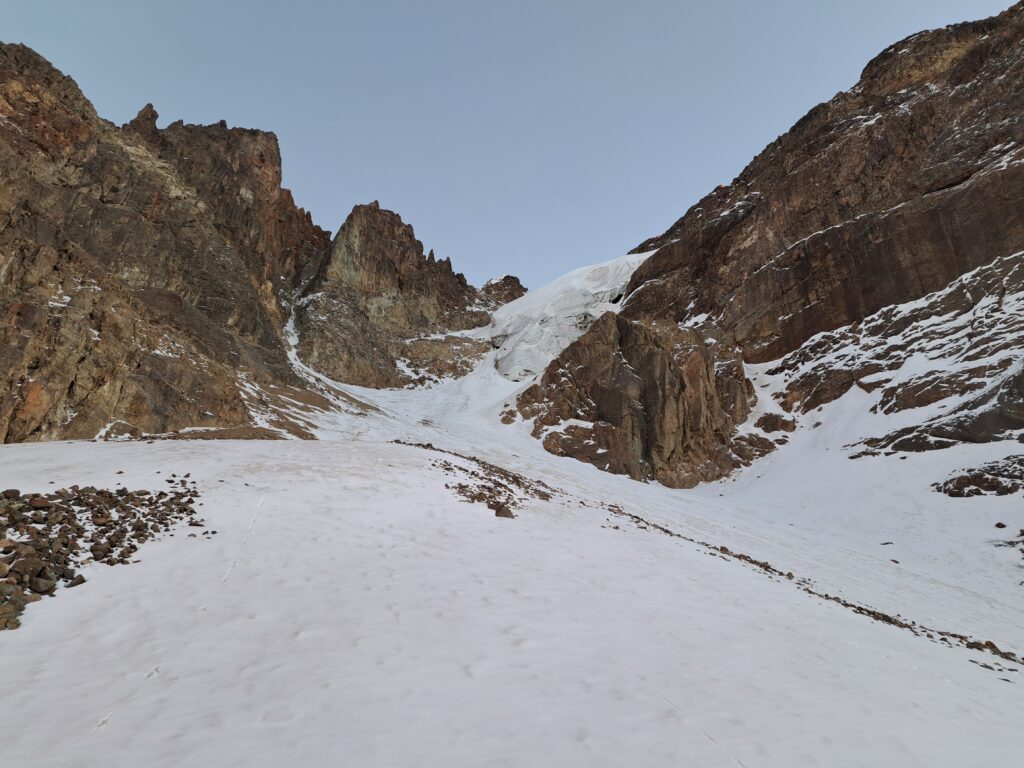
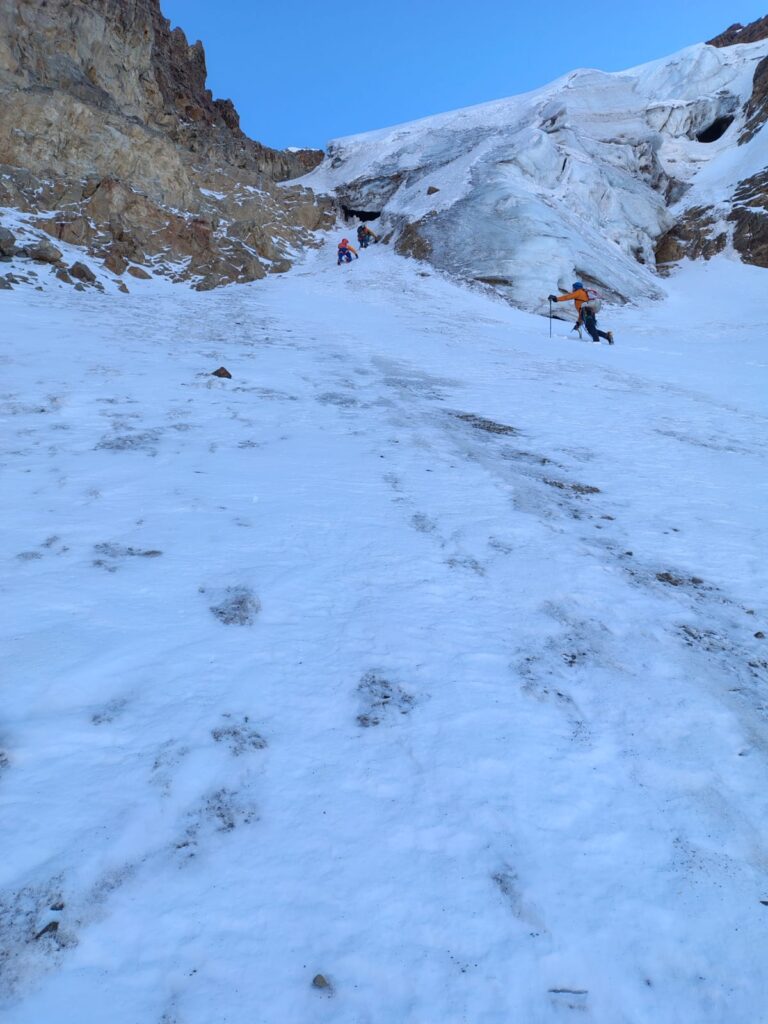
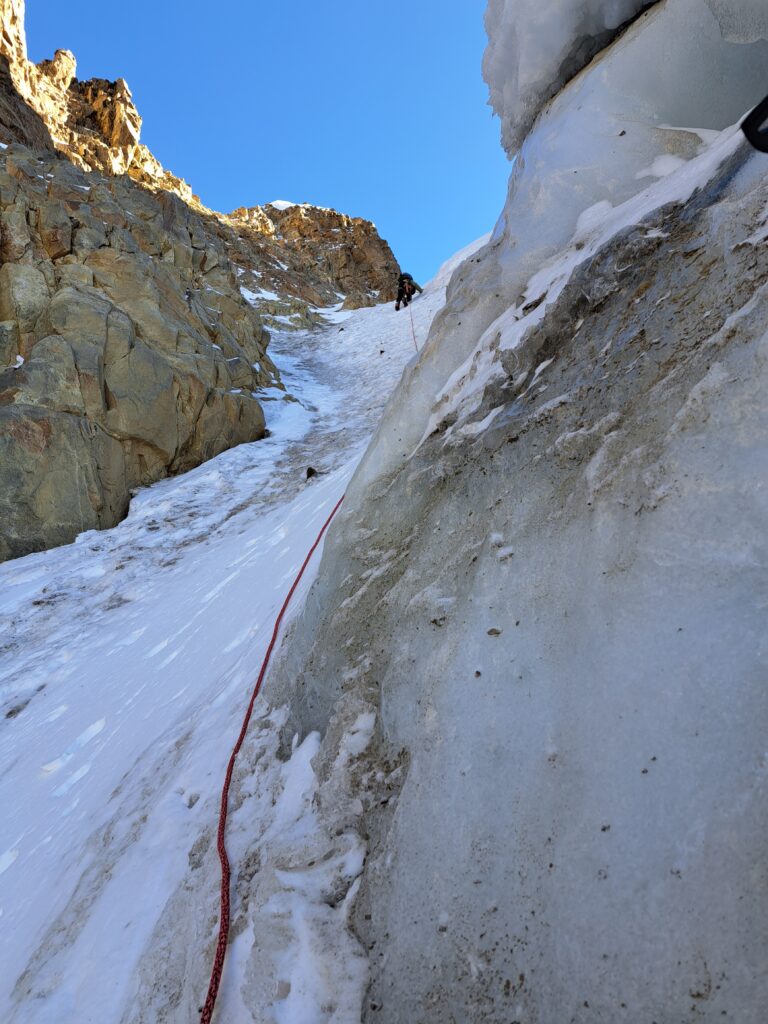
Because of the hard and steep ice, which reaches around 70 degrees in places, Rogier belays Chris. Belaying and placing ice screws always takes some time, so Alejandro and I decide to climb a little further to the left and above them. It’s pretty cold, so we are eager to get moving.
I start on the first pitch and it immediately gets serious: ice climbing on a vertical wall combined with mixed terrain. And all of this at 5,000 meters above sea level.
After the mixed terrain, I decide to climb straight up, towards Chris, who is above me. I place an ice screw because the ice above me doesn’t look particularly stable. I try to work my way up, but I can’t get through it.
So I climb back down and head left into the couloir.
I decide to leave the ice screw where it is. Later, I regret that decision.
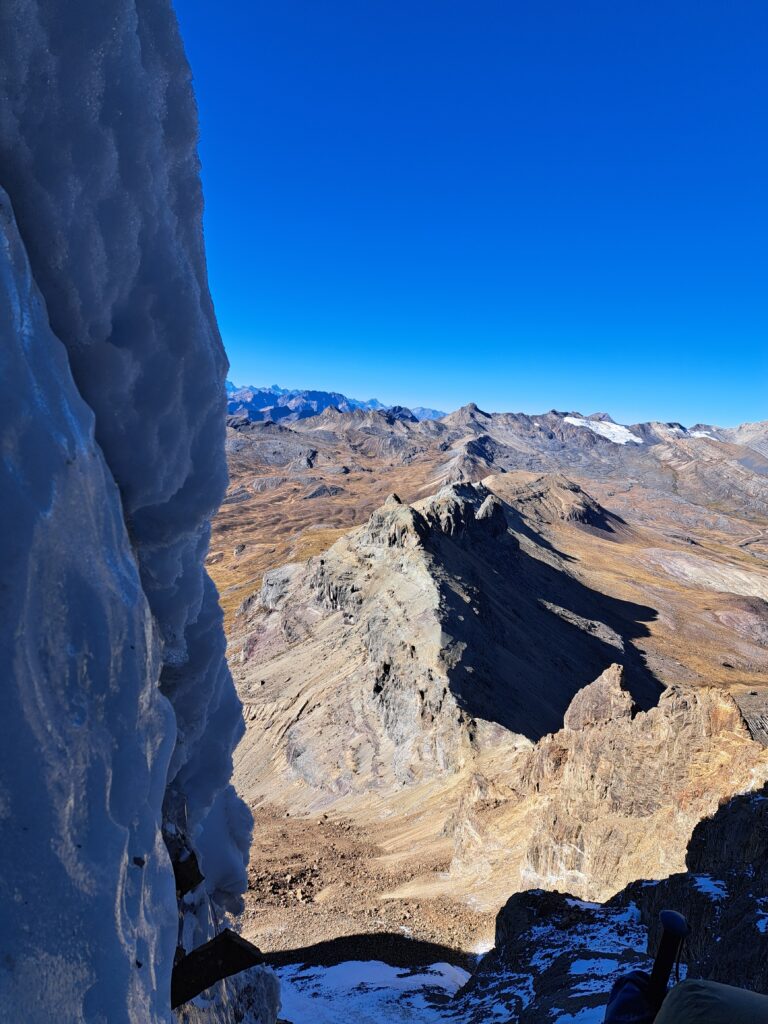
The couloir is also made up of hard ice, with occasional patches of snow. A little further on, I spot a nice section of ice on the right, with a kind of ledge where I can stand. I place my last ice screw here and pull in the rope.
Using a single ice screw as an anchor is normally not the safest way to belay. But the ice looks solid, so I trust it.
I pull in the rope and Alejandro starts climbing. Pulling in the rope with that high ice screw turns out to be quite a struggle, but a little later he is standing next to me.
He immediately continues on to the next pitch. That saves us a lot of time switching things around. When he reaches the top again, I follow, and suddenly we are above the crux.
From here, we still have a steep snow wall to climb before reaching the flat glacier plateau. Chris and Rogier are already waiting for us there.
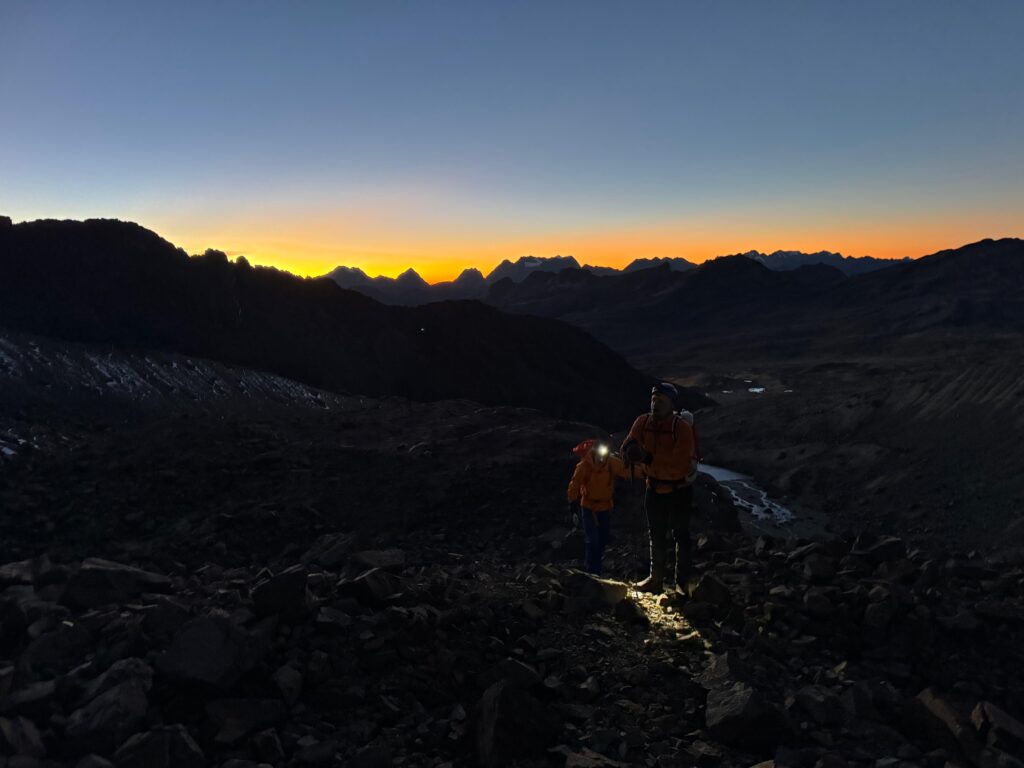
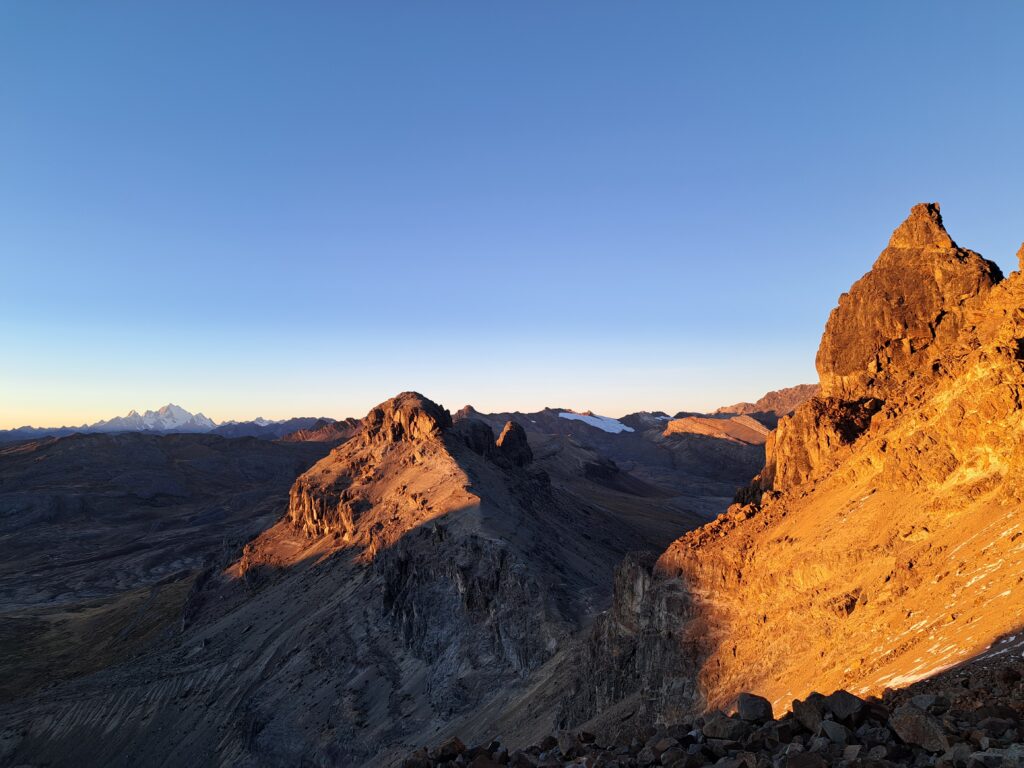
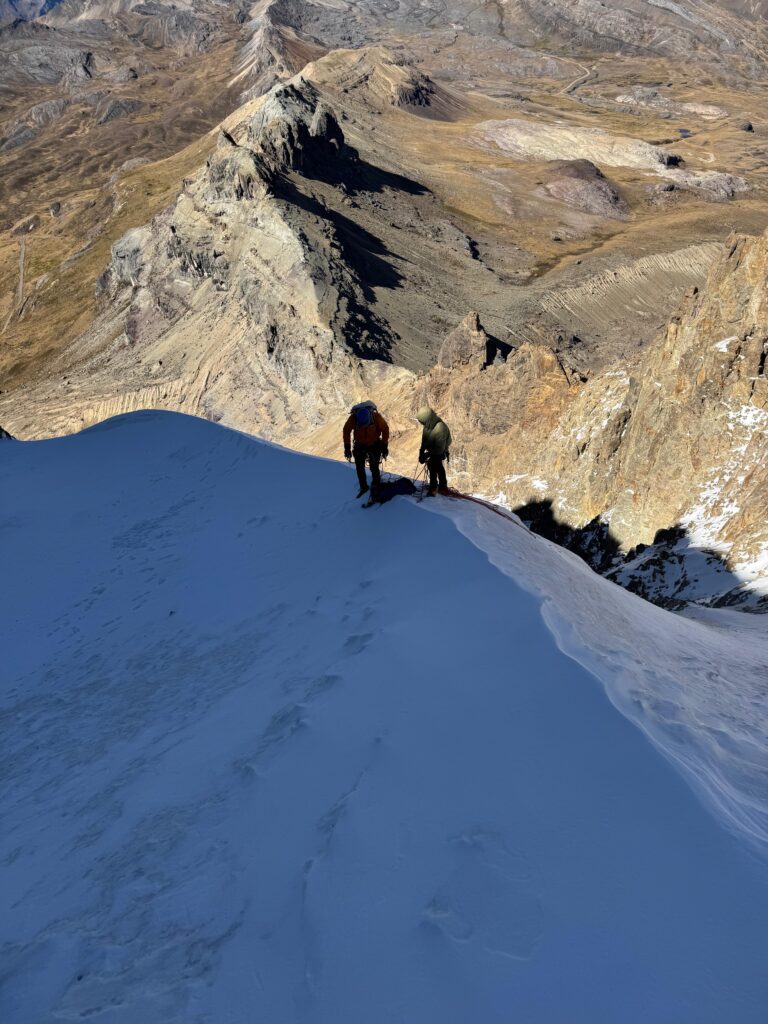
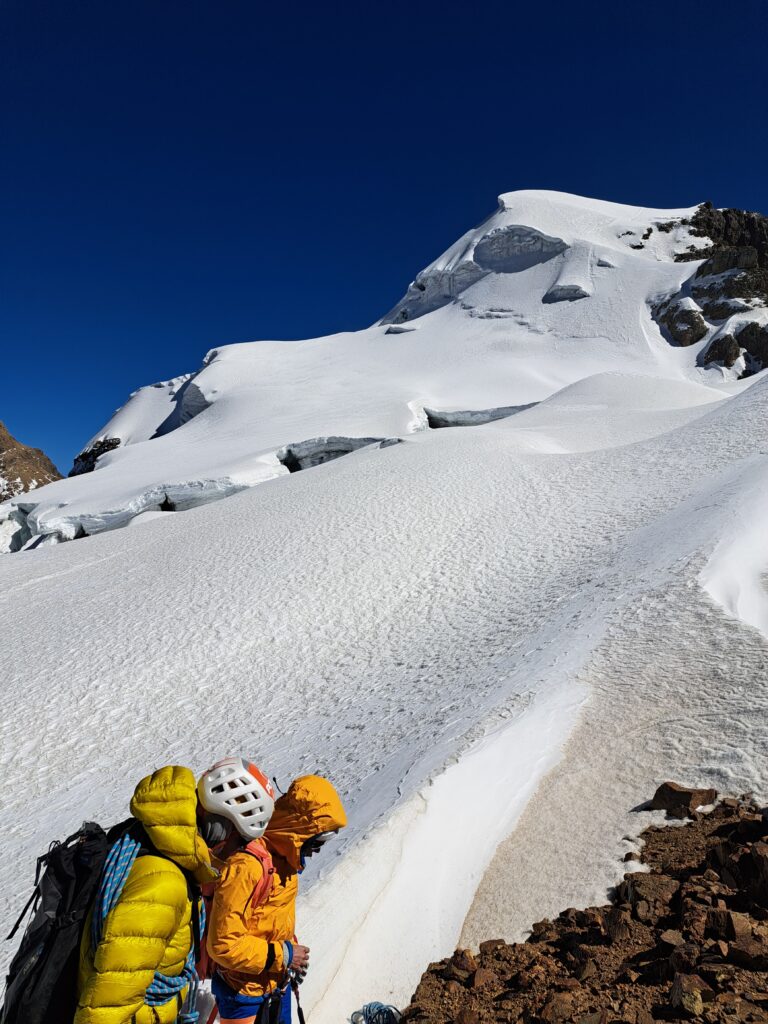
We take a short break to eat and drink something. The wind is incredibly strong on the glacier, so we don’t stay there for long.
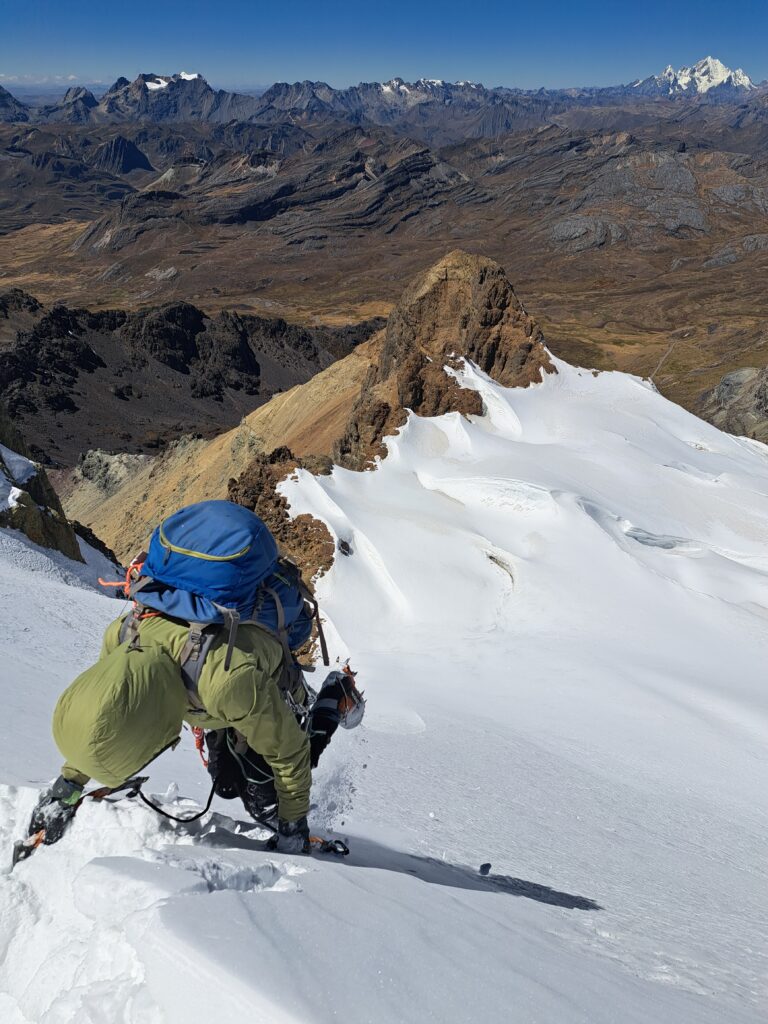
Alejandro and I set off first and cross the glacier towards the steep snow slope leading to the summit. Here the snow is much softer, and we start breaking trail.
I lead the way, and after a while the hard work at this altitude starts to take its toll. We climb underneath several seracs, so there is a certain urgency to keep moving.
After passing the seracs, I let Chris and Rogier go ahead so they can break trail for the final section. I also let Alejandro go first.
For me, it’s time to make the final part as comfortable as possible.
The slope here is around 60 to 65 degrees steep. I take five steps and then stop to catch my breath. Five more steps, and another pause. I keep doing this all the way to just below the summit, where Chris and Rogier are waiting for us.
We all come together, and then something intense happens.
I can hear the emotions in the men because of everything that has led up to this climbing trip. I can hear that neither of them is able to hold back their tears. And neither can I.
The week before I travelled to Peru, I lost my mother. She had been ill for a year and a half, and just before I was due to leave for the trip, her condition deteriorated rapidly.
On Monday, she decided she didn’t want to continue anymore, and on Tuesday she passed away.
The next day, Rogier came to see me, and I told him I had decided not to go anymore. But when he left with the duffel bag containing all the climbing gear, I became frustrated and started having doubts.
Would I regret this?
I thought about it for several more days and eventually decided to go after all.
The funeral was on Saturday, and on Sunday I was on a plane to Peru. There had hardly been any time to process everything or give it a place.
After my disappointment on Yanapaccha, I was more determined than ever to make this climb a success and dedicate it to my mother.
Just before the summit, Rogier and Chris told me that this mountain was for her.
And that’s when I broke down.
We explained to Alejandro what was happening, and he was incredibly understanding. He also felt that it was a very special moment.
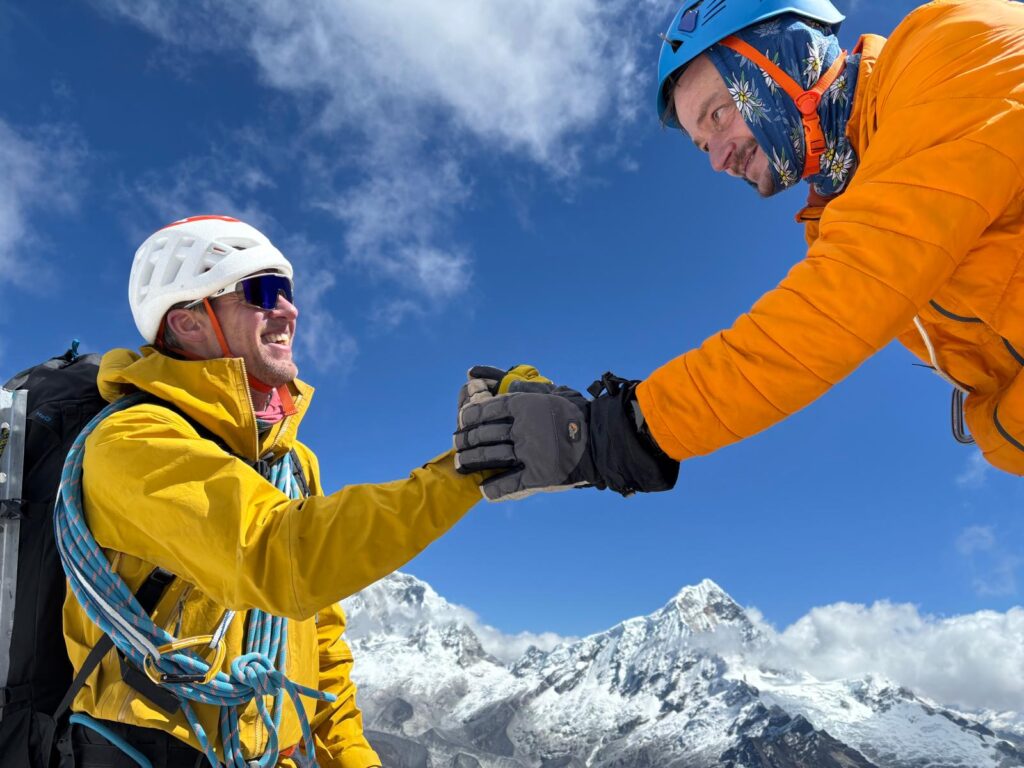
We all hold on to each other and walk the final meters to the summit together.
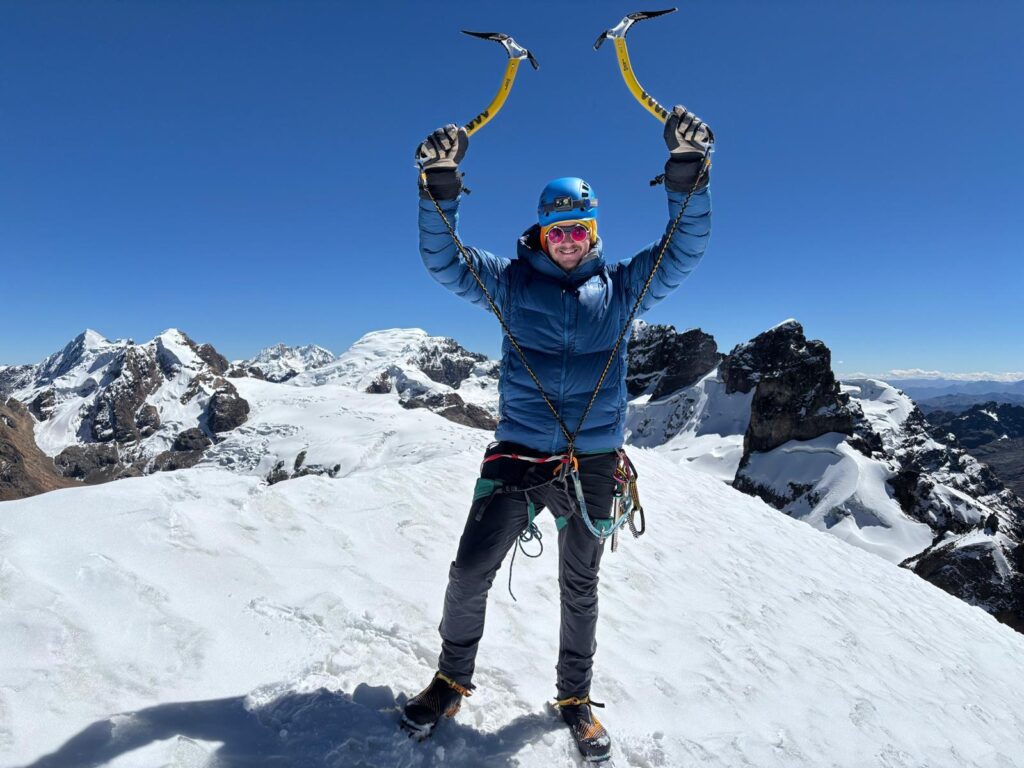
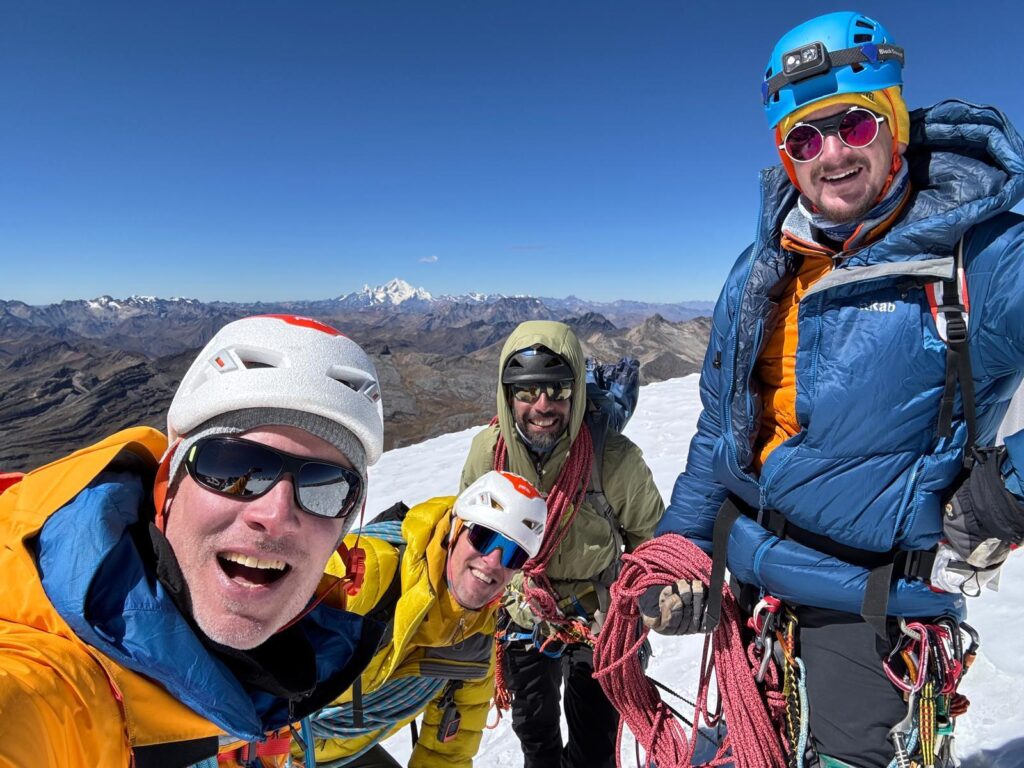
Once we reach the top, the emotions slowly shift towards happiness and pride. Pride that the four of us have managed to do this together.
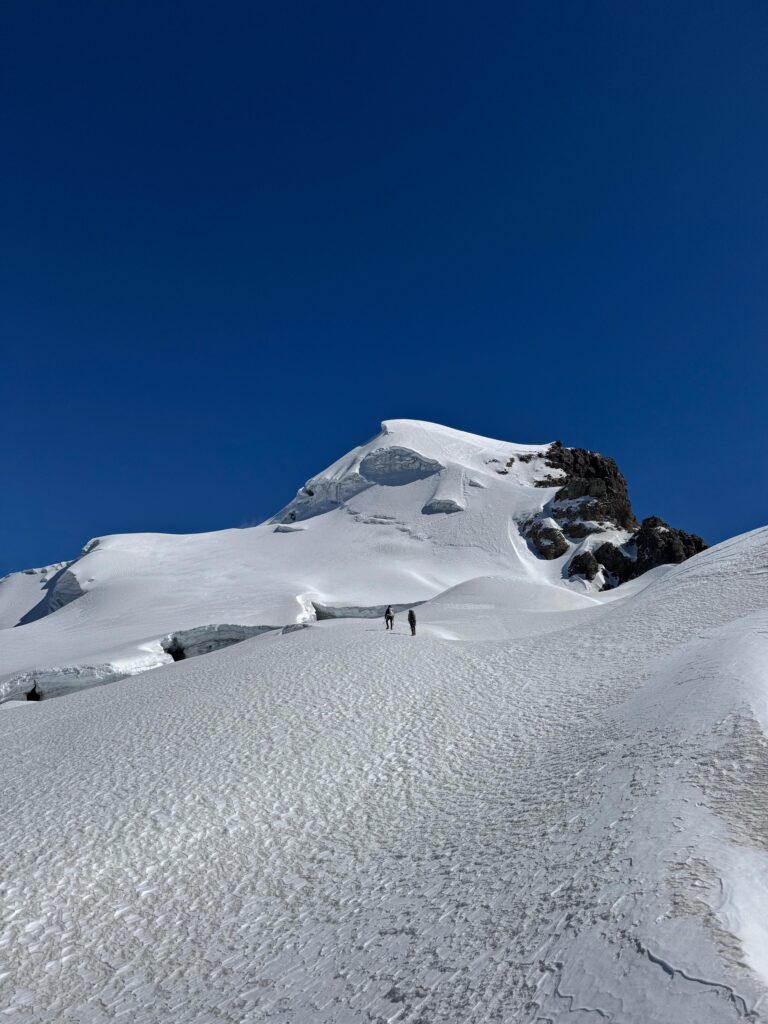
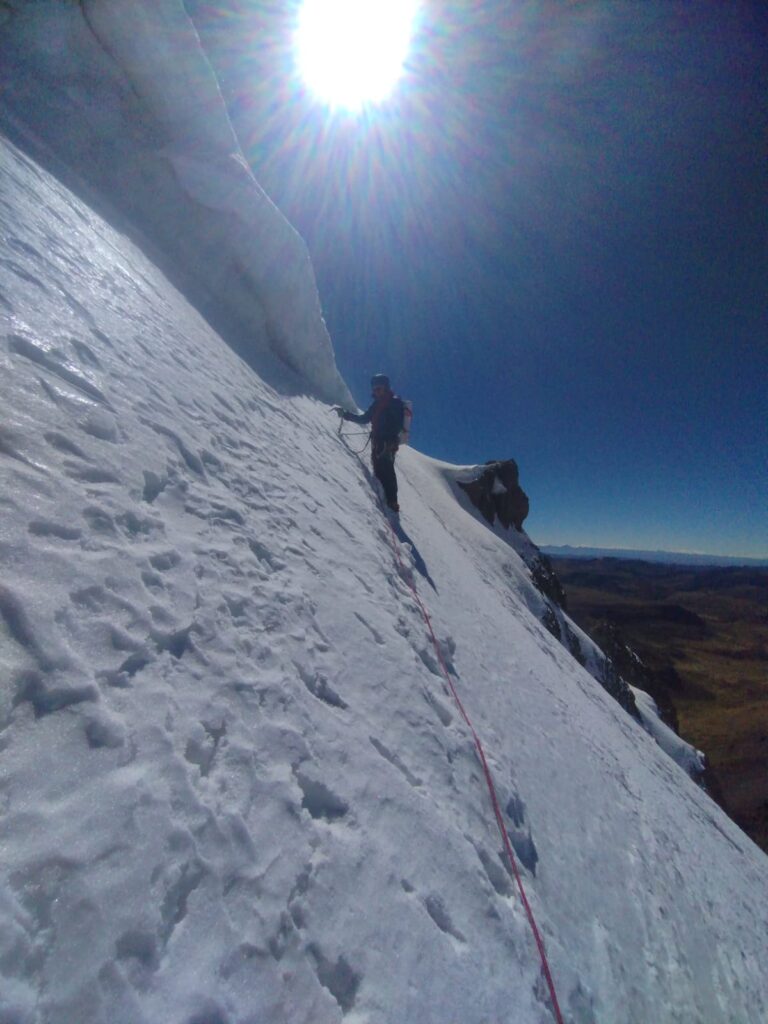
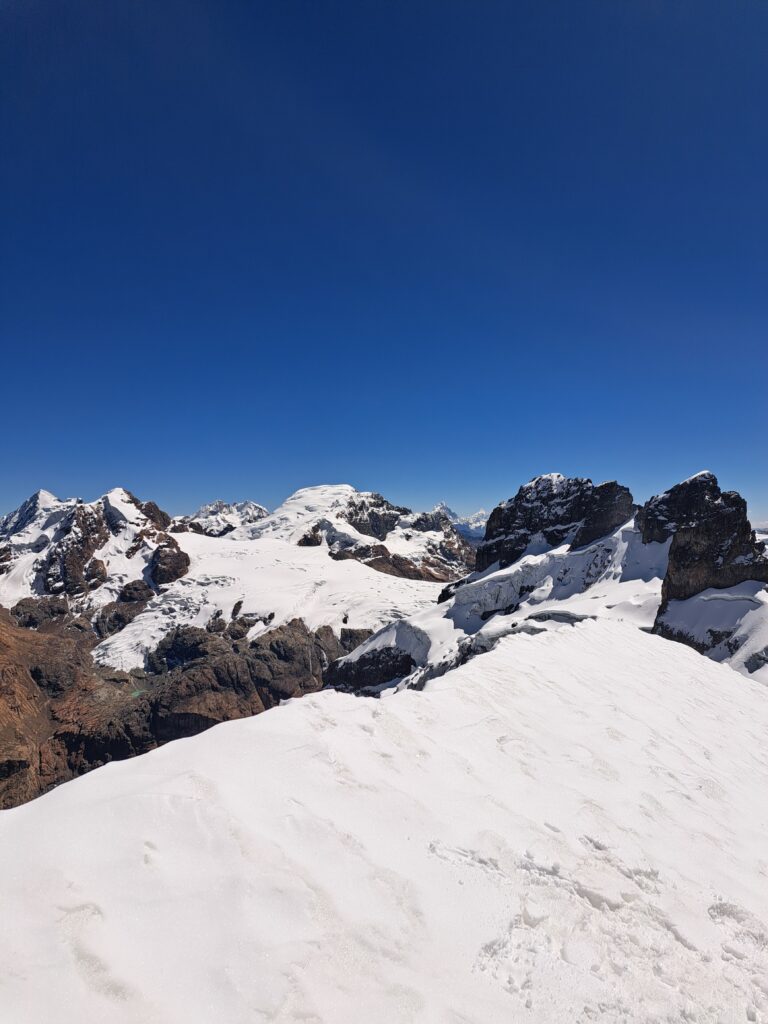
We take some summit photos and videos and then decide to start descending quickly.
The sun is now doing its best and is shining directly onto the snow slope. This causes the snow to soften, making it less stable.
We also decide to descend without the rope. Rogier and Chris take the same route we used on the way up, while Alejandro and I descend a little lower down. The two teams stay close together.
Not that there is much we could do if someone were to slip, but it still gives us a sense of safety.
Before long, we are back on the glacier and head towards our previous resting spot. We quickly eat and drink something, and then the exciting descent begins.
At the top of the wall, we discuss our options and decide to build a snow anchor, a “deadman.” We cut a slot into the edge of the snow and bury the anchor.
Chris ties into Alejandro and tests whether the anchor is secure enough. Everything looks solid, and he sets up the rappel.
He rappels down dozens of meters to the Abalakov anchor they had found on the way up.
Rogier follows, then me, and finally Alejandro.
At the Abalakov, we rebuild the rappel and continue descending.
First Chris, then me, followed by Rogier, with Alejandro bringing up the rear once again.
Once we are all safely down, we pack away our gear and continue descending towards the road, where the taxis are waiting.
We exchange phone numbers with Alejandro and jump into the car.
During the drive, we listen to our favorite singer, Kiara Lozano from the band Corazón Serrano, and talk through the entire day.
Back at the apartment, all the energy has completely drained out of us.
We grab something to eat around the corner, chat for a while at the apartment and then head to bed early.
July 28 - Nevado Ulta Chico, the mountain from which I could no longer escape the exhaustion
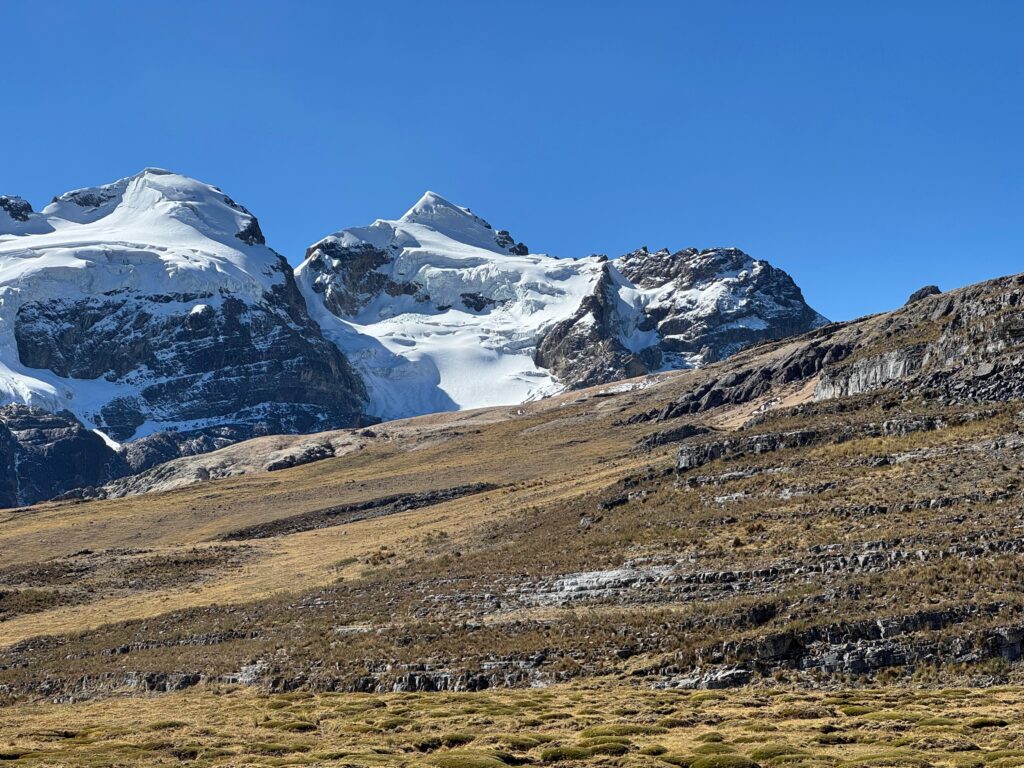
After our rest day, today we are set to climb Nevado Ulta Chico.
Once again, this is a one-day ascent from Huaraz. The mountain lies opposite Nevado Mateo, which we climbed earlier in the trip.
At 4:30 a.m., the alarm goes off and we get ourselves ready. Half an hour later, we are on the road towards Punta Olímpico, the starting point for our climb.
As soon as we arrive, the clouds begin to roll in and the sky closes in around us. We don’t expect to get much of a view higher up.
Oh well. We’ll see how it goes.
It takes roughly an hour to reach the foot of the glacier, but for me it turns out to be a tough hour. Yesterday I had already noticed a deeper kind of fatigue, and today it is clearly still there.
Fortunately, Chris and Rogier pull me through it. Once we reach the glacier, I quickly down an energy gel.
Thankfully, I can feel some energy returning.
We get out the climbing gear and rope up.
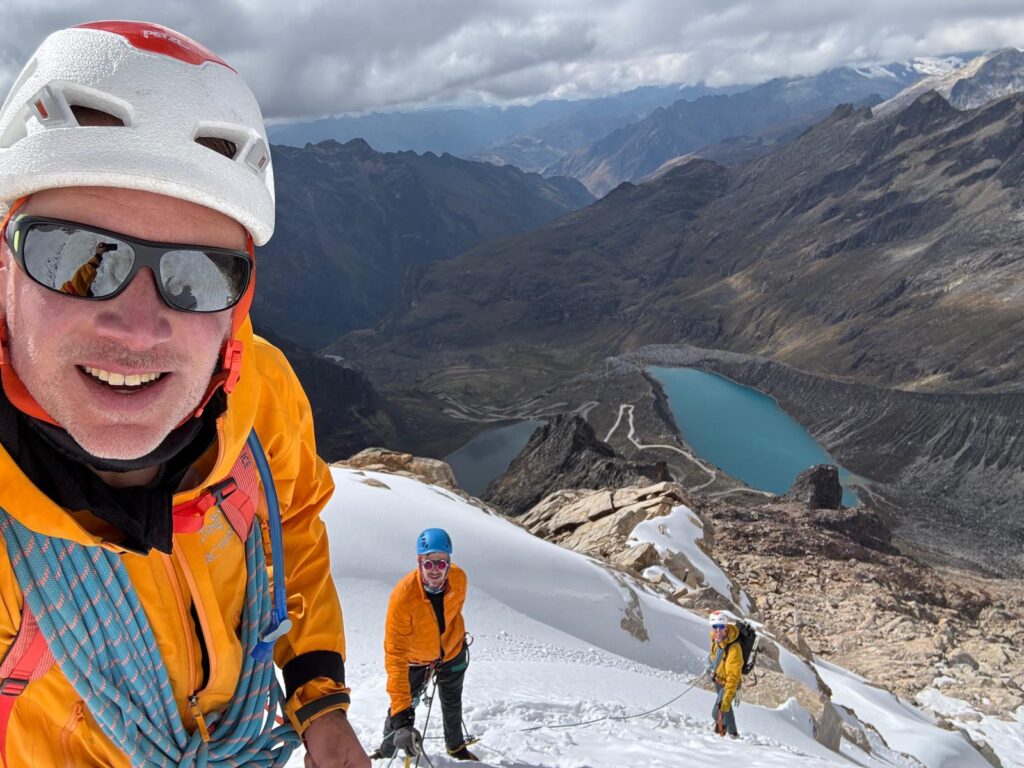
Rogier leads, I climb in the middle and Chris brings up the rear.
We step onto the glacier and a little further on reach a kind of split in the route. We discuss which way to go.
The route to the left looks more inviting, while the right-hand option is steeper. But from the right we can also see a more direct line towards the summit ridge.
We choose right.
We cross the steep snow slope until we reach the base of a roughly 60-degree snow wall.
We give Rogier the full length of the rope and he starts up the face.
There are several crevasses along the way, but Rogier navigates them skillfully, traversing across the wall and making his way upwards.
Once he reaches the top, he builds an anchor and Chris and I follow.
From the ridge, we have a clear view across to Nevado Mateo.
It is absolutely packed with climbers. Hordes of people are making their way up the mountain.
We realise once again how lucky we were to climb it earlier in the week.
We continue along the summit ridge. This time Chris takes the lead while I belay him.
He climbs the entire pitch, after which Rogier and I follow.
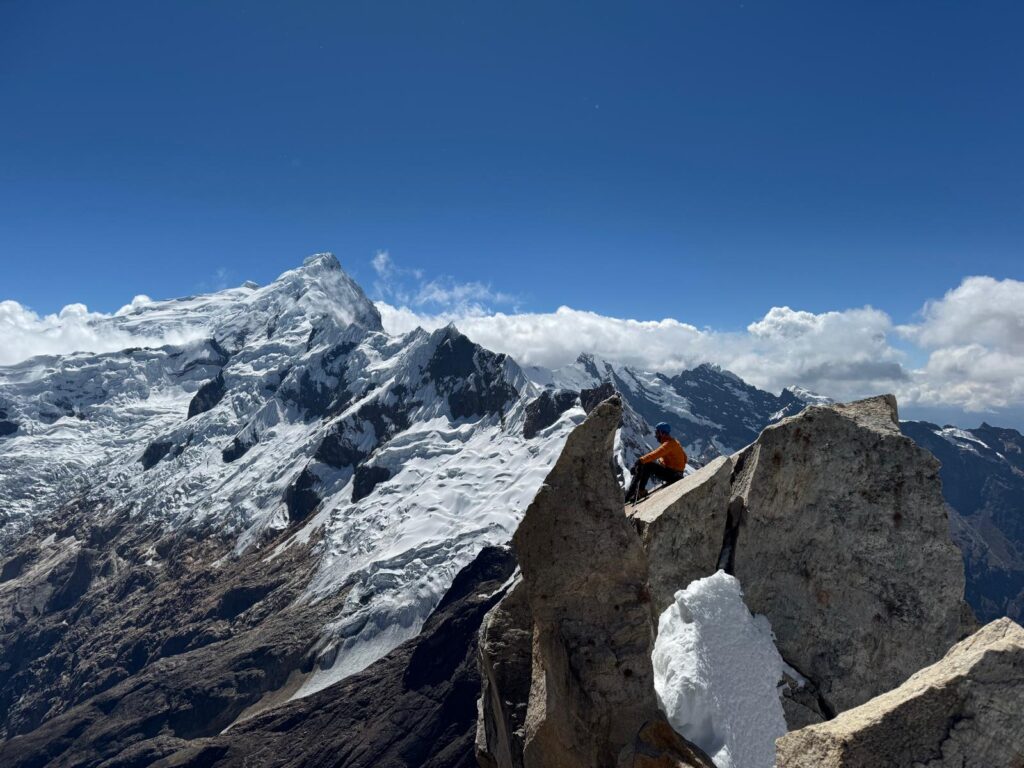
A rocky ridge leading to the summit of a mountain in the Cordillera Blanca is relatively unusual. Because of the altitude, most of these peaks are covered in snow and ice.
So climbing on rock is a welcome change.
We are thoroughly enjoying ourselves.
And then, suddenly, we are standing on the summit of Nevado Ulta Chico at 5,350 meters.
Another successful ascent.
For the other two, it is their fourth 5,000-meter peak of the trip. For me, it is my third.
Despite everything that has happened in the lead-up to this trip, I can now honestly say that my journey to Peru has been a success.
We had bigger plans, but life doesn’t always follow the plans you make. Sometimes you have to adjust your goals to the circumstances you’re faced with.
And, as they say, reaching the summit only means you are halfway there. The descent is often more dangerous than the climb itself.
So we quickly get moving again and start descending.
We make three rappels and descend efficiently towards the bergschrund.
Rogier traverses the bergschrund first. I shout that I’d like to jump across it.
And at exactly the moment I say it, I slip.
I stumble straight into the crevasse.
That was not quite what I had in mind!
Chris is already above me with the spike of his ice axe buried in the snow. His reaction time is impressive.
I have instinctively turned myself around during the slip as well and managed to drive my own ice axe into the snow.
All things considered, it is a fairly harmless incident.
We laugh about it and continue down the glacier.
Before we know it, we are back on the rocks where we started the climb.
We unrope, pack away our equipment and start walking down.
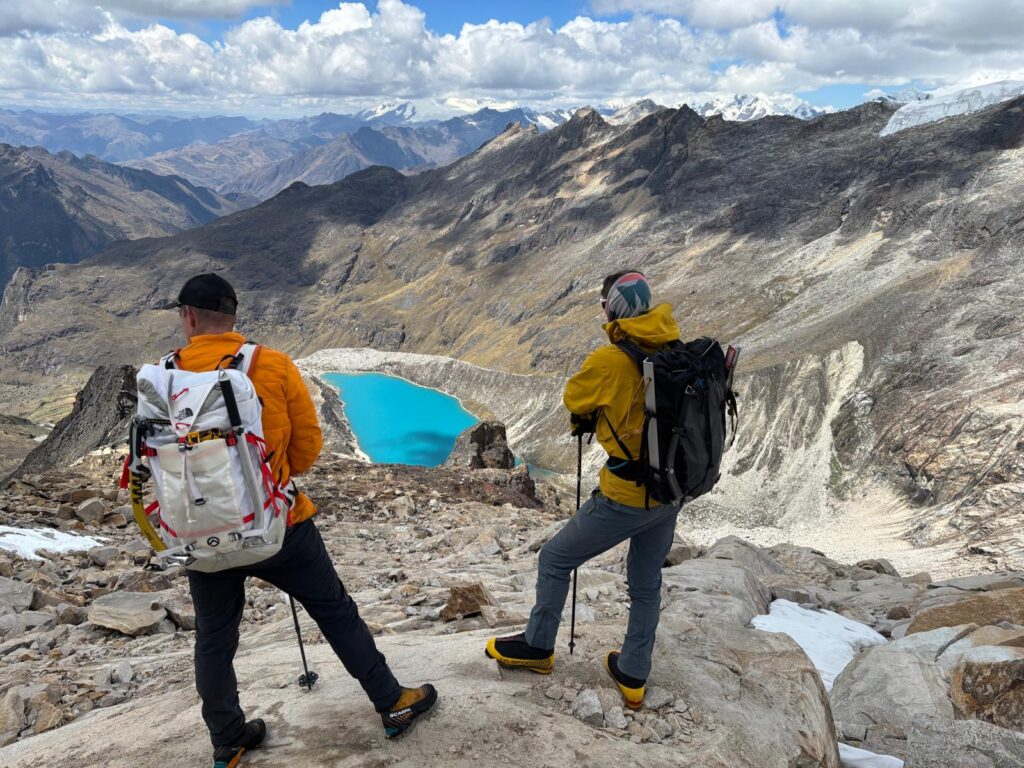
In the distance, we can see the deep blue lake surrounded by the mountains.
We walk back down while talking constantly, and soon find ourselves back at the lakeshore.
It has become considerably busier with tourists. Given the spectacular scenery, I can understand why.
After eating and drinking something, we get back into the car and our driver takes us back to Huaraz.
This was our final climb together as a team.
Rogier is leaving for Panama in two days.
We discuss how we want to celebrate the end of our climbing partnership, and we quickly agree on the answer.
Once back at the apartment, we shower, change clothes and head straight into the Peruvian nightlife.
After this incredible adventure, we embarked on another trek through the southern Cordillera Blanca, but more about that later…