Alphubel, the stormy summit
Täsch
Switzerland
Before: The plans
For some time now, Wilco and I have had a route in mind in the Mischabel Massif in Switzerland, the Täschhorn-Dom traverse. These are the two highest peaks of the massif, separated by a kilometer-long ridge, entirely above 4,000 meters. To complete such a route, the conditions must be perfect. But in the mountains, the weather is impossible to predict…
Monday, September 8: Between hope and fear
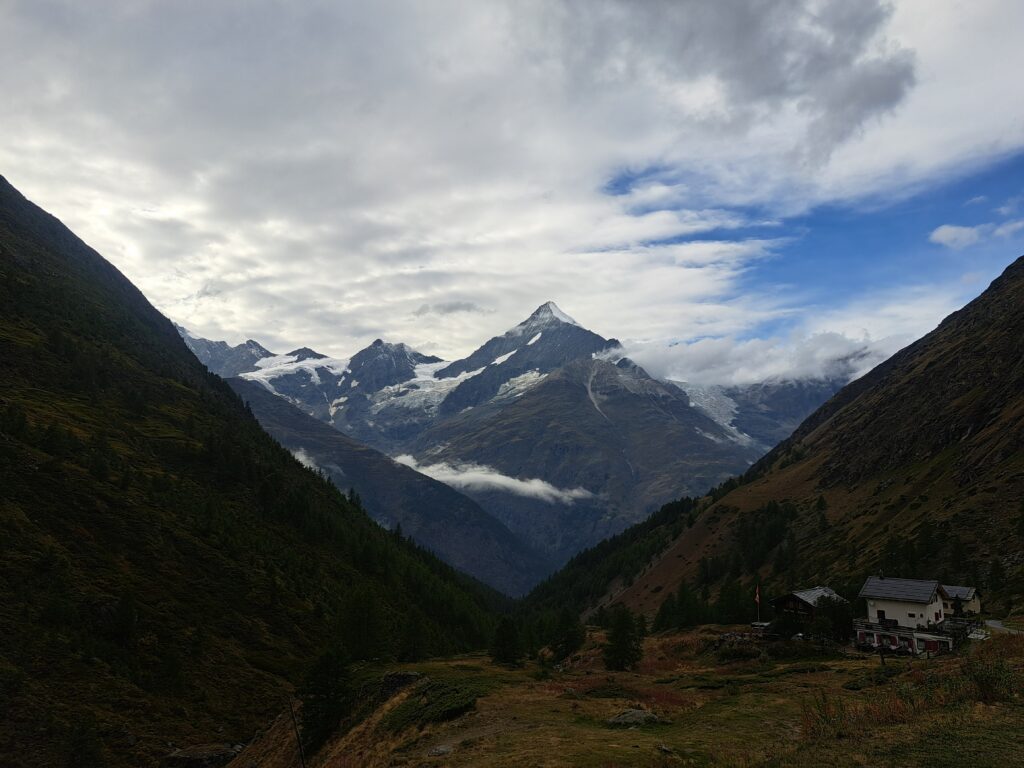
On Monday, we drove towards Switzerland. Unfortunately, the weather forecast for the coming days was downright bad. As soon as we entered the Alpine region, it started raining. The weather is often worse on the north side than on the south side, but unfortunately, that wasn’t the case either. Nevertheless, we drove towards Täschalp to walk to the Täschhütte from there. We parked the car and saw that the weather was starting to clear up a bit. Would it all turn out alright after all? We began our hike to the hut, and the sun was shining ever more intensely. We had a beautiful view of the Weisshorn across the valley and quickly took off a layer of clothing. When the sun is shining, you could really feel it. After about 50 minutes, we arrived at the hut at an altitude of 2701 meters. We checked in and could immediately start preparing dinner. After filling our bellies, we ask the hut lady about the weather forecast for tomorrow. What she tells us isn’t what we’d hoped for: cloudy and rainy all day. With these conditions, the intended destination is definitely a no-go. Perhaps we can still climb the Alphubel.
The Alphubel is a 4,206-meter-high glaciated mountain next to the Täschhorn. We would have to cross this mountain anyway to reach the Mischabelbiwak, the starting point of the traverse. The weather was supposed to improve after 10:00 AM, so we decided to have breakfast at 7:00 AM instead of 4:00 AM. We didn’t fancy walking to the mountain for hours in the rain, only to start the climb soaked. The woman looked at us with some surprise when we told her we wanted to have the late breakfast. Normally, it’s out of the question to go up the mountain this late because the snow softens as the day goes on. But after we explained that we didn’t want to go through the rain, she understood. Now it was time to go to bed, and then we’ll see what tomorrow brings.
Tuesday, September 9: The fight for the summit
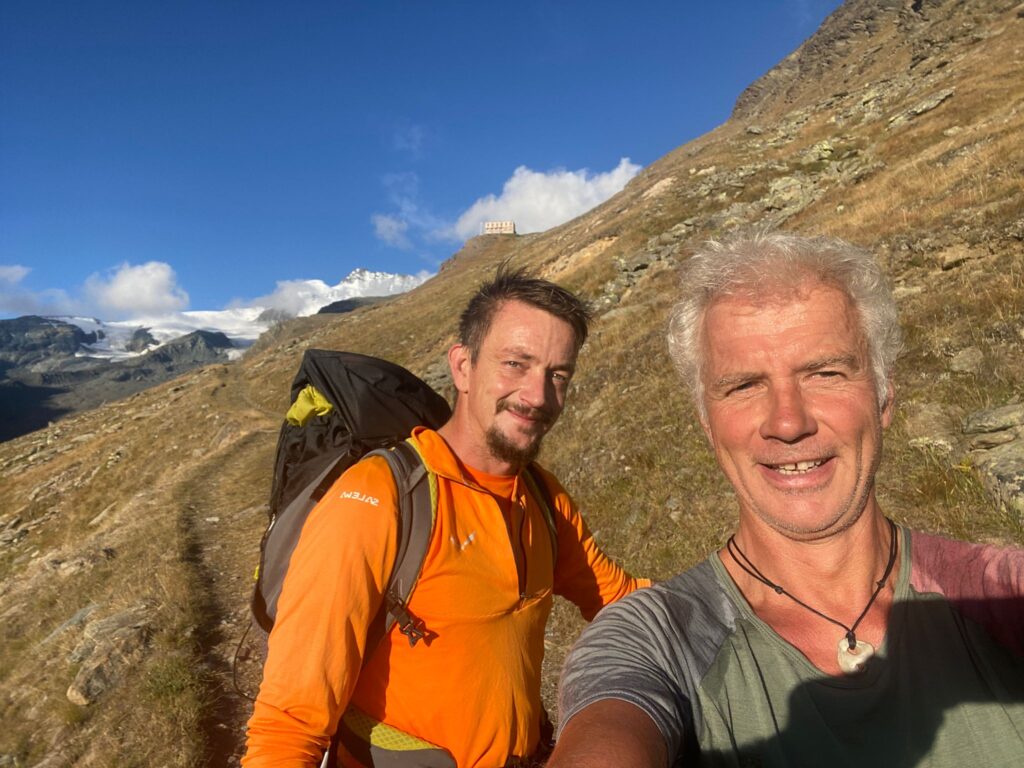
The alarm goes off and we wake up after a wonderful night. It’s certainly not a punishment to get up in the morning instead of in the middle of the night. We go downstairs and eat breakfast. The weather doesn’t look good, and we decide to wait until it improves. Around 9:30, it finally dries up a bit, and we decide to give it a try. We leave the hut and head towards the mountain where the route begins. After about 50 minutes, we arrive at the first glacier. We decide to take the moraine on the right instead of going over the glacier. After all, we’ll encounter plenty of snow and ice in the coming hours. But a little later, we can’t avoid it. We have to cross the glacier to reach a rock formation where the next ice mass awaits us. There’s not much left of the glacier, so we leave the rope in our backpacks for a while. It’s not a steep section, and we soon reach the rocks. After this, the ice slope becomes much steeper, but after another brief discussion, we decide not to rope up yet. There’s little fresh snow, so we can see the crevasses. Here too, things move quite quickly, but the clouds are thickening, and our visibility is decreasing. Slowly but surely, we get closer to the Alphubeljoch at 3,772 meters.
Once there, visibility is completely gone. The wind is also increasing, and it starts to snow softly. The conditions are deteriorating steadily; we can just see where our next step is. Now we’re climbing up the Saas Valley side, where significantly more fresh snow has fallen. To our left, we see the snow ridge leading to the Eisnase, a somewhat steeper route to the summit. This is normally a route that’s in good condition early in the season, but it’s shorter than the usual route. We quickly reach our destination and take the Eisnase. I lead the way towards the ridge. It’s a fairly steep climb, and the fresh snow makes it hard work. Wilco occasionally suggests we change positions, but I tell him I’m okay. But after a while of stamping snow at 4,000 meters, I start to get a bit tired, and Wilco quickly notices. We also exchange and roped up.
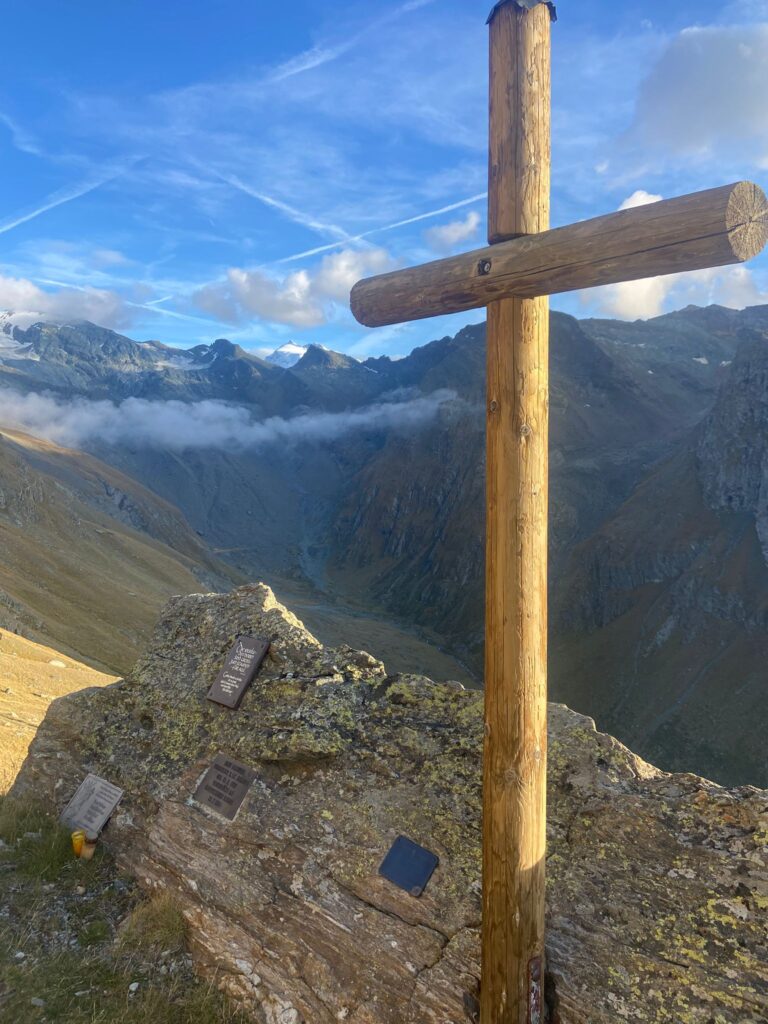
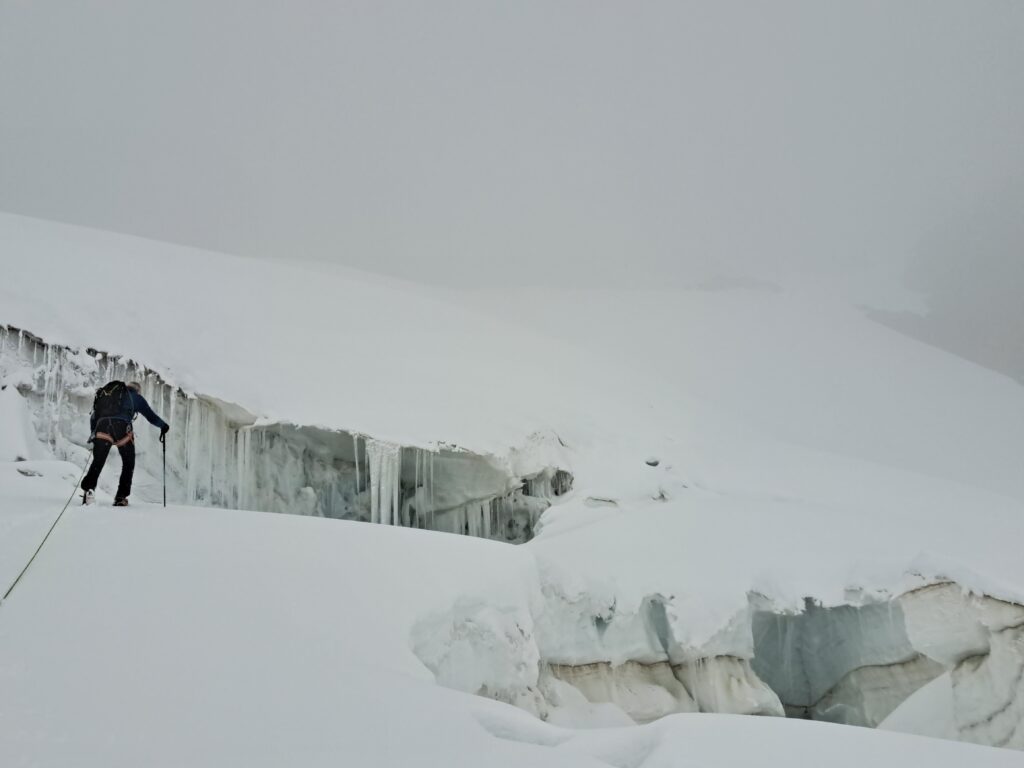
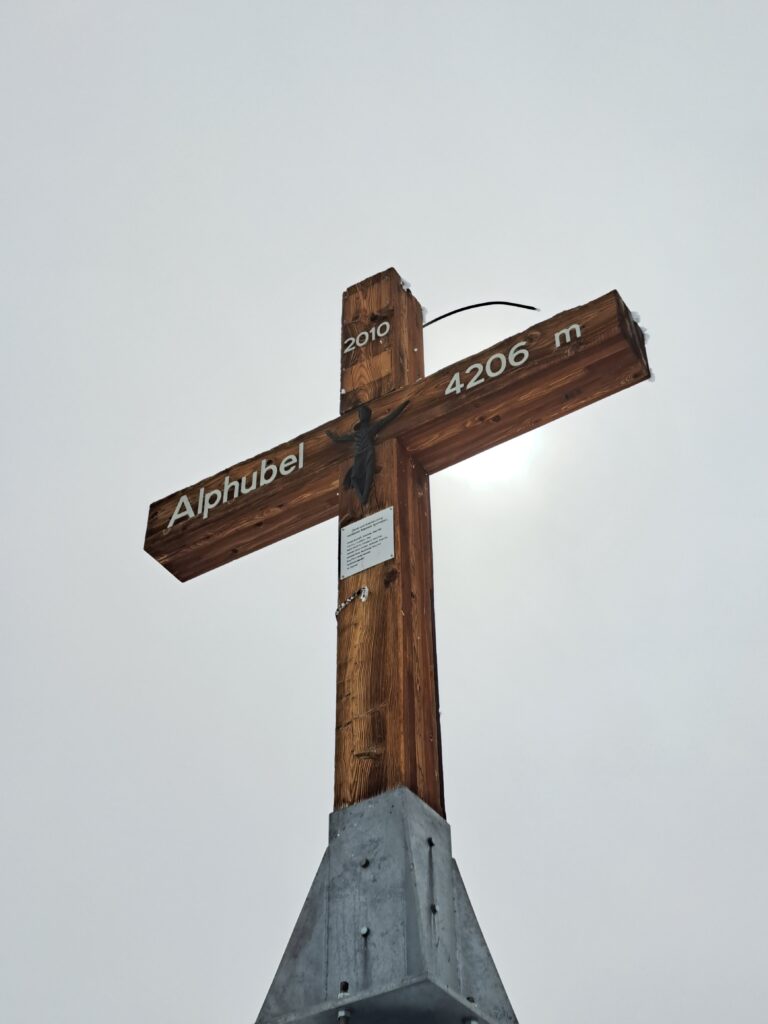
Further on, we see a large crevasse and safety comes first. Wilco easily traverses the crevasses and then we reach the summit ridge. Here, we first scramble over a rock formation before finally reaching the Eisnase. Of course, it’s completely out of shape; there’s no patch of fresh snow, just ice. That makes the climb a bit different. Wilco climbs the first section and decides to use an ice auger just in case. I’ve brought my technical crampons, and they’re a bit easier to climb in steeper ice than Wilco’s regular crampons. After the Eisnase, we arrive at the kilometer-wide snow plateau of the summit. Wilco starts filming and shouts: “We’ve got him!” But unfortunately, I had to tell him we still have a few meters to climb towards the summit cross, which is not yet visible. We laugh and continue along the now wide ridge. Because of the dense fog, it’s so difficult to see where we’re putting our feet that we occasionally misstep and end up next to the ridge. Oh well, falling off the Alphubel would be an achievement, so we continue on the last few meters with renewed vigor. And then the summit cross finally appears out of the mist. Phew, we’ve made it!
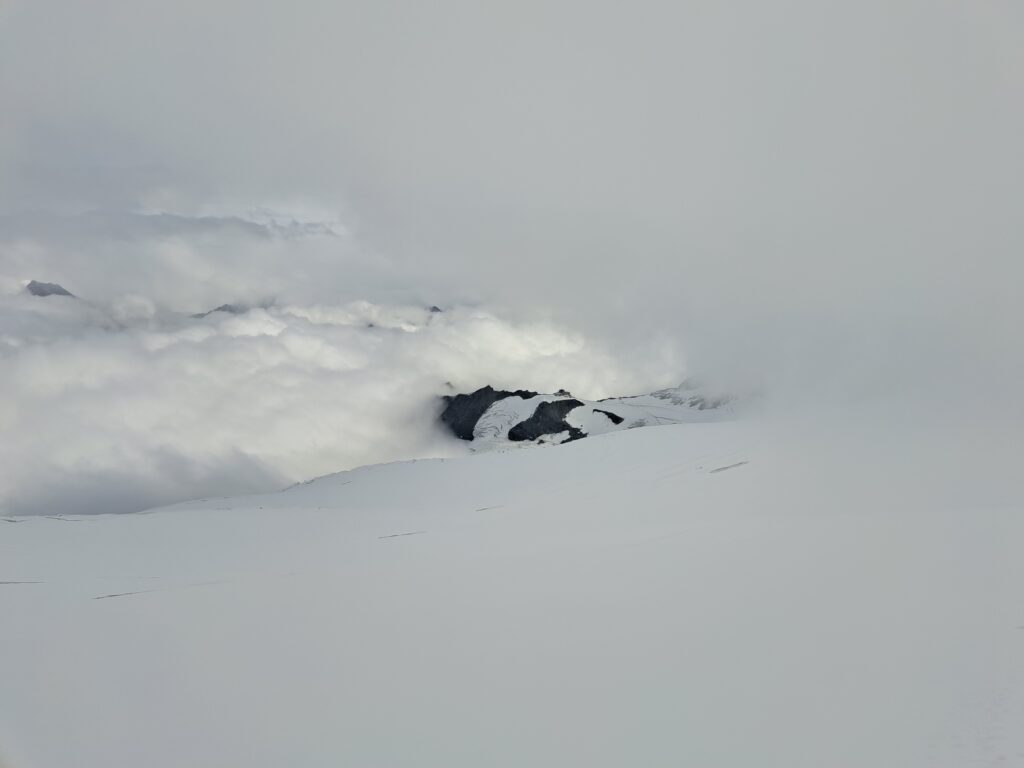
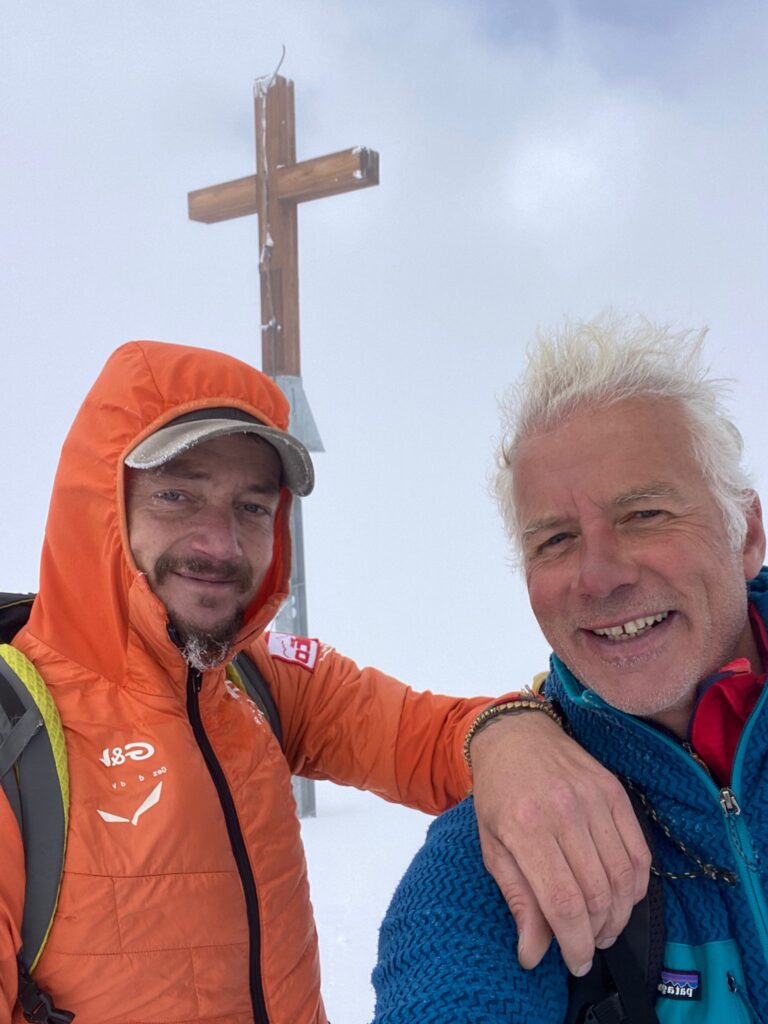
We take some photos and videos and take a short break. But soon we cool down in the biting wind and begin our descent via the normal route. The wind picks up more and more, and the snow is now blowing almost horizontally in our faces. Sometimes I can barely keep my eyes open. We’re also slowly getting soaked. Time to get out of here! While we felt like we reached the summit of the Alphubeljoch quite quickly, the descent back down seems to take forever. We traverse a few hundred meters above the route indicated on the GPS, because we don’t want to end up too low. After a considerable amount of slogging, we get a view of our next destination, the Alphubeljoch. I take more and more short breaks and shout to Wilco that I’m having a hard time. He completely understands me and shouts back: “That’s okay!” Once we reach the Alphubeljoch, we descend the steeper glacier but go completely the wrong way. We’re still in a complete whiteout, so I keep checking my phone to see if we’re going anywhere. And thank goodness I am, because I have no idea where we’re going.
But now we’re on the right track, and a little later, Wilco sees our tracks from the outward journey. We practically fly down now that the route is clear, and soon leave both glaciers behind us. We get lower and lower, and the visibility improves. Finally, we can see some of the surroundings again. At the foot of the glacier, we stow our climbing gear and walk back to the hut. We wonder aloud if this section of the outward journey was also long, because it seems endless. Every now and then, I check my watch to see how high we’re still, a clear sign that we’ve had enough for today. At the hut, we throw off our clumsy hiking boots and go inside for a drink. We warm up in the hut and recover from the struggle. Neither of us has been at high altitude much this year, and you really notice it. Wilco has completed a fantastically successful expedition across the Pacific Ocean to raise awareness that clean drinking water isn’t a given and that we waste too much of the water we depend on. I myself have taken a kind of sabbatical from the higher mountains because I made the choice to pay attention to my sick mother and care for her to the fullest. Sometimes it takes a step back to take two steps forward. After our break, it’s time to head back to the car and drive back to civilization. We’ll finish the day with a delicious pizza and a large glass of beer.
Wilco, thanks for listening to my struggles and your advice. A loyal climbing partner is important, a loyal friend even more so. Cheers!
Get In Touch
Ready to embark on your next adventure or looking to enhance teamwork and cooperation within your organization through exhilarating experiences? Feel free to contact us. We’d love to discuss how Bart Van Bemmel’s expertise in mountaineering and extreme sports can create unforgettable journeys and valuable lessons tailored to your needs. Get in touch today to start your unique adventure or team-building experience.
kkk